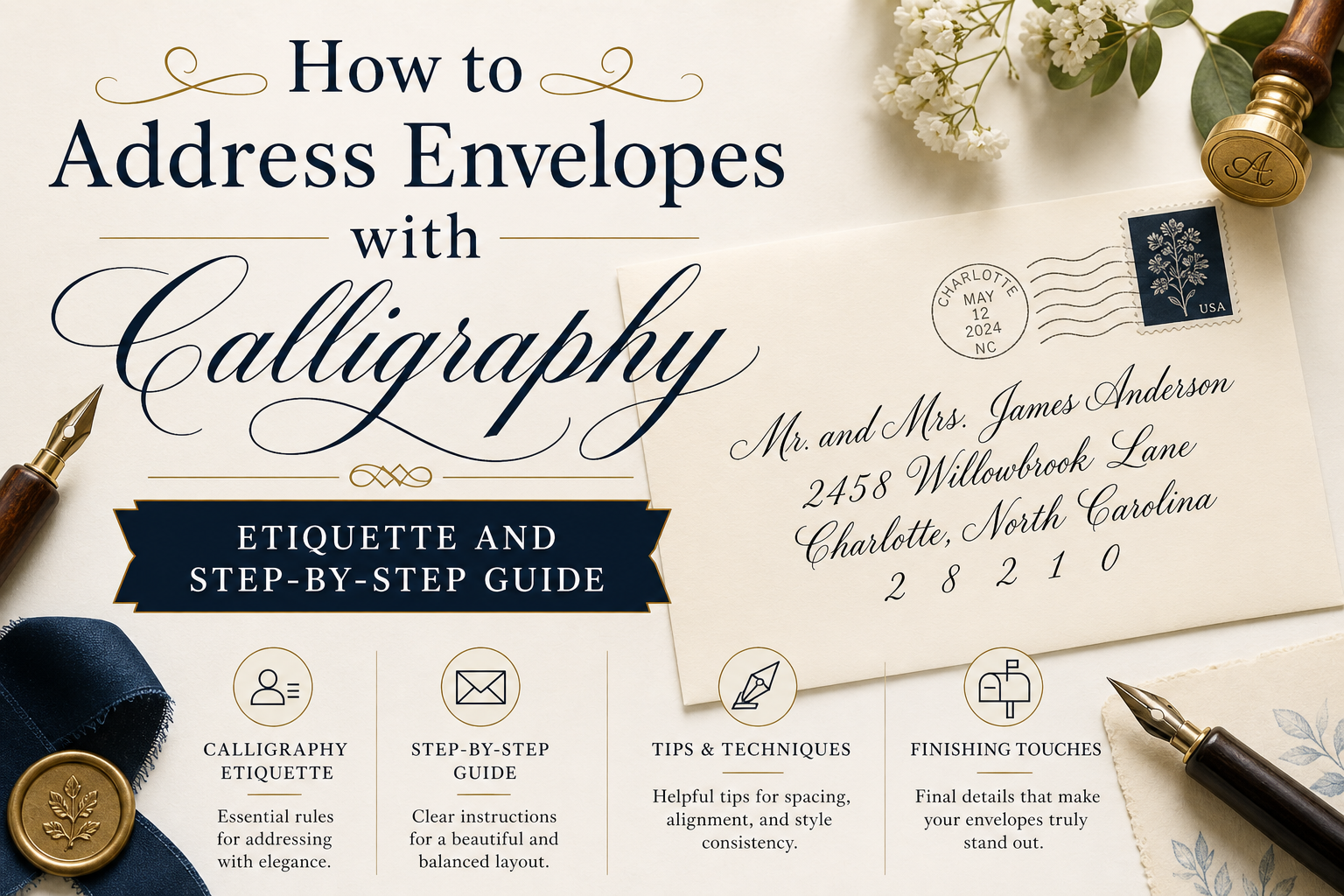


To address an envelope in calligraphy, write the recipient’s full name and any applicable title on the first line, the full street address on the next line, and the city, state, and ZIP code on the final line — centered on the envelope with the name line in your most decorative lettering and the address block in slightly more restrained, highly legible script, since postal sorting depends on clarity above all else.
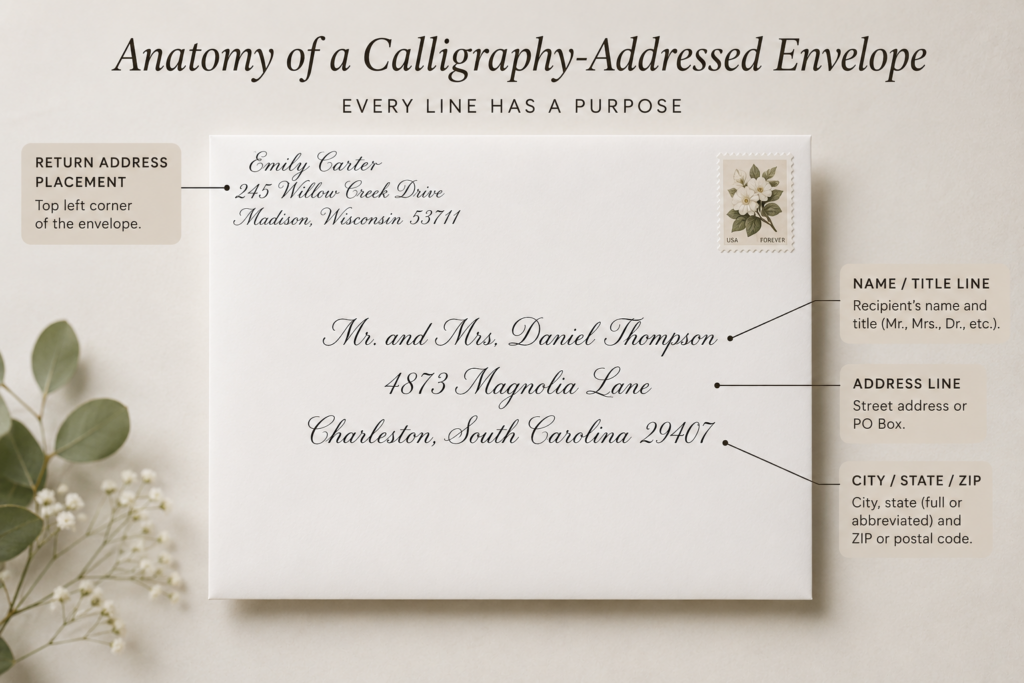
Calligraphy on an envelope turns routine mail into something the recipient notices before they’ve even opened it — whether it’s a business letter, a formal invitation, a holiday card, or a simple thank-you note. This guide covers the complete process for addressing any envelope in calligraphy, standard USPS formatting conventions, formal title etiquette, and how the approach shifts depending on envelope type and occasion. If you’re specifically addressing wedding invitations, our dedicated wedding envelope calligraphy guide covers that etiquette in full detail — this guide is the broader reference for everything else.
Standard Envelope Address Format (USPS Conventions)
Before the calligraphy itself, it helps to understand the standard format postal services expect, since legibility and correct formatting genuinely matter for reliable delivery.
Recipient address block (centered on the front of the envelope):
- Recipient’s full name, with title if applicable
- Address Line 1 — street number and street name (and apartment or suite number, if it fits on the same line)
- Address Line 2 (if needed) — apartment, suite, or unit number, when it doesn’t fit on Line 1
- City, State, ZIP code — on the final line, with the state abbreviated using the standard two-letter USPS code (for example, CA for California, NY for New York)
Return address (top-left corner or back flap): Your own name and address, in the same basic format, typically in a simpler, less decorative script than the recipient’s name line, since it’s functional rather than the visual focal point.
A few USPS formatting standards worth knowing:
- Use the official USPS state abbreviations rather than spelling out the state name in full, which keeps the address line appropriately concise for automated sorting.
- Keep the ZIP+4 code if you have it, since it can improve delivery accuracy, though the standard 5-digit ZIP code is sufficient for reliable delivery.
- Avoid abbreviating the city name, even if abbreviating the street type (St., Ave., Rd.) is acceptable and common practice.
- For apartment or unit numbers, “Apt,” “Unit,” or “#” are all acceptable, but staying consistent within a single envelope looks more polished than mixing conventions.
How to Address an Envelope in Calligraphy: Step by Step
- Confirm the full, correctly spelled name and complete address before you begin — corrections on a finished calligraphy envelope are difficult to make cleanly.
- Choose your script. Copperplate remains the most traditional, formal choice for envelope addressing; Modern Calligraphy suits a more relaxed, contemporary look. See the script section below for guidance on choosing between them.
- Lightly sketch guide lines in pencil, or use a light box or ruled template, to keep your layout centered and consistent before committing in ink.
- Write the recipient’s name and title first, in your largest, most decorative lettering, since it’s the visual anchor of the entire envelope.
- Write the address block beneath it, using a slightly smaller, more restrained version of your script — legibility matters more here than on the name line, since this is what postal sorting actually depends on.
- Let the ink dry fully before handling the envelope, particularly with metallic inks or heavier paper stock that absorbs ink more slowly.
- Complete a test envelope first if you’re addressing a large batch, to confirm your layout and spacing before committing to your full stack.
- Add postage last, after confirming its placement won’t overlap or interfere with your address block.
Addressing Envelopes for Different Occasions
Business and professional mail: Keep the script more restrained and highly legible — an elegant but simple Italic or clean Copperplate reads as professional without sacrificing the clarity a business recipient expects. Skip heavy flourishing, which can read as overly casual in a professional context.
Formal invitations (non-wedding): Milestone birthday parties, formal dinners, and gala or fundraiser invitations follow similar principles to wedding envelope etiquette — full name and title on the recipient line, address on the following lines — but with slightly more flexibility in script choice depending on the event’s specific tone.
Holiday cards: A warmer, more personal script (Modern Calligraphy or brush lettering) suits the more casual, personal nature of holiday mail, and consistency across a full mailing list matters more here than in a smaller, more formal batch.
Thank-you notes: A quick, elegant script that’s still clearly legible works best — thank-you notes are typically a smaller batch, making them a good lower-stakes way to practice envelope calligraphy before a larger, more formal project.
Sympathy or condolence cards: A restrained, dignified script (Italic or simple Copperplate without heavy flourishing) is generally the most appropriate tone for this occasion specifically.
Addressing Formal and Professional Titles
Getting a title right matters, particularly for professional or formal correspondence — here’s how to handle the most commonly asked-about titles.
Attorneys: Use “Esquire” (abbreviated “Esq.”) after the full name instead of “Mr.” or “Ms.” before it — for example, Sarah Jenkins, Esq. Note that “Esquire” and a courtesy title like “Mr./Ms.” are not used together; choose one or the other.
Clergy and pastors: “The Reverend” typically precedes the full name for many Christian denominations — for example, The Reverend Michael Lee. If addressing a pastor along with their spouse, the standard convention is The Reverend Michael Lee and Mrs. Lee, though some couples prefer both full names listed separately, particularly if the spouse also holds a professional title.
Doctors: “Dr.” precedes the full name for both medical doctors and PhDs — for example, Dr. Amara Johnson. For two doctors in the same household, Doctors Sarah and John Smith, or Dr. Sarah Smith and Dr. John Smith if you prefer both names spelled out separately, are both correct.
Judges: “The Honorable” precedes the full name for sitting judges — for example, The Honorable Patricia Lin — a convention that also applies to many elected officials and ambassadors.
Military titles: Rank precedes the name and takes priority over a standard courtesy title — for example, Captain James Wilson, with the rank spelled out in full rather than abbreviated for formal correspondence.
Professors: “Professor” or “Dr.” (if they hold a doctorate) precedes the full name, depending on the specific institution’s convention or the individual’s own stated preference where known.
For the complete etiquette breakdown specifically for wedding guest addressing — married couples, families with children, plus-ones — see our wedding envelope calligraphy guide.
Addressing an Envelope “In Care Of” Someone Else
When mail needs to reach someone through another person or organization — a guest staying with a host, or a package sent through a workplace — use “c/o” (in care of) between the two names:
Jane Smith c/o Michael Johnson [Street Address] [City, State, ZIP]
This tells postal services and the recipient’s household exactly who the mail is intended for while directing it to the correct physical address.
Different Envelope Types and How Addressing Changes
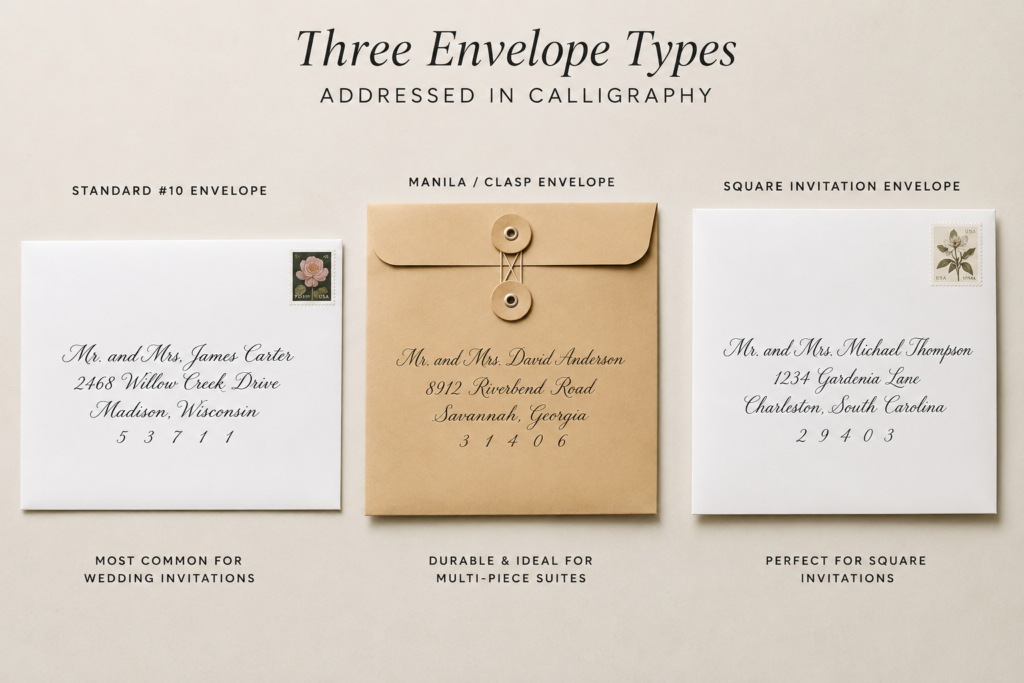
Standard #10 business envelope: The most common format for letters and formal correspondence, with address placement following the standard format outlined above.
Manila or clasp envelopes (larger, flat mail): These larger envelopes have more surface area, giving you room for a bigger, more decorative name line if desired, though the address block itself should still follow the same basic structure and remain clearly legible for sorting. Because these envelopes are often used for documents or larger flat items, double-check that the added weight doesn’t require additional postage before finalizing your calligraphy layout around the stamp placement.
Square or invitation-style envelopes: Popular for formal invitations and greeting cards, these often have less predictable proportions than a standard rectangular envelope, making a pencil layout sketch especially important to avoid running out of space partway through the address block.
Choosing a Calligraphy Script for Envelope Addressing
Copperplate (Roundhand) remains the most traditional and most-requested script for formal envelope addressing, with its elegant, engraved-looking thick-thin contrast. For the complete breakdown of this script, including tools and technique, see our Copperplate vs Italic guide.
Modern Calligraphy suits more casual or contemporary correspondence — holiday cards, personal letters, or informal invitations — with a faster learning curve for anyone addressing their own envelopes for the first time.
Italic offers a structured middle ground: more formal than Modern Calligraphy, but faster to learn and more consistently legible than Copperplate, making it a strong choice for business correspondence specifically.
For the complete comparison of every major calligraphy style and which suits which purpose, see our full guide to types of calligraphy styles.
Common Mistakes When Addressing Envelopes in Calligraphy
- Prioritizing decoration over legibility on the address block. The name line can carry more flourish; the address lines need to remain clearly readable for reliable postal sorting.
- Skipping a pencil layout on unfamiliar envelope shapes or sizes. Square and oversized envelopes in particular catch beginners off guard with unexpected spacing issues.
- Inconsistent title formatting within the same mailing batch. Pick one convention (abbreviated vs. spelled-out titles, for example) and use it consistently across every envelope in a batch.
- Placing the stamp before finishing the address block, risking overlap with your final lines of calligraphy.
- Not testing ink and envelope paper together first. Some coated or heavily textured envelope stocks cause bleeding or feathering that only becomes apparent once you’ve already started your real batch.
Frequently Asked Questions
Write the recipient’s full name and title on the first line in your most decorative lettering, the street address on the next line, and the city, state, and ZIP code on the final line, keeping the address block especially legible for postal sorting.
The recipient’s name and title go on the first line, the street address on the next line, and the city, state (abbreviated), and ZIP code on the final line, centered on the front of the envelope with your return address in the top-left corner or back flap.
Use “Esquire,” abbreviated “Esq.,” after their full name instead of a courtesy title before it — for example, “Sarah Jenkins, Esq.” Esquire and a title like Mr. or Ms. are not used together.
Write the intended recipient’s name on the first line, followed by “c/o” and the host or intermediary’s name on the second line, then the complete address on the lines below.
“The Reverend” typically precedes the pastor’s full name, followed by their spouse’s name — for example, “The Reverend Michael Lee and Mrs. Lee” — though listing both full names and titles separately is also an accepted, increasingly common alternative.
The core address format is the same, but manila and clasp envelopes offer more surface area for larger, more decorative lettering, and their added weight may require additional postage, which is worth confirming before finalizing your layout around the stamp.
Copperplate is the most traditional and formal choice, particularly for professional or formal correspondence. Modern Calligraphy suits casual mail like holiday cards, and Italic offers a faster-to-learn, still-formal middle ground well suited to business correspondence.
Use the official two-letter USPS state abbreviation (for example, CA for California or NY for New York) rather than spelling the state name out in full, which keeps the address line appropriately concise for postal sorting.
It’s optional, but many calligraphers use a simpler, less decorative version of their script for the return address, keeping the recipient’s name and address as the clear visual focal point of the envelope.
Include “Apt,” “Unit,” or “#” followed by the number, either at the end of Address Line 1 if it fits, or on its own Address Line 2 if it doesn’t – staying consistent with whichever convention you choose across a batch.
Whether you’re addressing a single formal letter or an entire mailing list, getting the format and etiquette right is just as important as the lettering itself. Get in touch about custom envelope calligraphy for an upcoming project, or see our wedding envelope calligraphy guide if you’re specifically addressing wedding invitations.