

Calligraphy ink selection is one of the most underestimated decisions in the craft. Most guides focus almost entirely on paper-based inks and leave the vast landscape of specialty surfaces, including glass, metal, leather, wood, and fabric, either ignored or covered in a single vague paragraph.
This guide covers the best calligraphy inks for every major surface category you are likely to encounter, whether you are working on fine wedding stationery, personalizing perfume bottles, creating live event installations, or producing fine art commissions on unconventional materials.
The Fundamentals of Ink-Surface Compatibility
Before exploring specific ink and surface pairings, understanding the core factors that affect compatibility helps you make confident decisions when you encounter a surface or project that is not covered directly in any guide.
Surface Absorbency
Paper absorbs ink. Non-paper surfaces typically do not. This single difference changes everything about how ink behaves on application.
On absorbent surfaces, ink wicks into the material, providing natural adhesion and spread. On non-absorbent surfaces like glass or metal, ink must dry through evaporation or chemical bonding rather than absorption. This requires either a specialist ink with adhesion properties or a sealant applied afterward.
Surface Texture
Smooth surfaces allow nibs to glide cleanly. Rough or textured surfaces catch nib tines and produce scratchy, inconsistent strokes. The relationship between surface texture and nib type is a critical compatibility factor for any surface where you plan to use a traditional dip nib.
Ink Chemistry
Water-based inks behave differently from alcohol-based inks, oil-based inks, and solvent-based inks. Understanding the basic chemistry of your ink tells you how it will behave on different surfaces, how it needs to be sealed (if at all), and which applications it is genuinely suited for.
Best Inks for Paper: The Core Category
Paper remains the primary surface for most calligraphy work, and the range of available inks is correspondingly wider than for any other surface.
Sumi Ink (Best All-Round Black Ink for Paper)
Sumi ink is the professional default for most pointed pen calligraphy on paper. Made from carbon particles suspended in water with a shellac or similar binder, it produces a deep, matte black that dries quickly and photographs exceptionally well.
Yasutomo Sumi Ink and Speedball Super Black India Ink are both reliable options at accessible price points. For the richest black and finest line quality, Kuretake Sumi Ink is the choice of many professionals working in formal wedding stationery.
Sumi ink flows consistently through pointed nibs without clogging, dries to a permanent waterproof finish, and is compatible with most smooth calligraphy papers. It is the recommended starting ink for any beginner learning pointed pen scripts.
Iron Gall Ink (Best for Depth and Historical Work)
Iron gall ink has a blue-black color when first applied that oxidizes over time to a deep, rich brown-black. This historical characteristic gives iron gall calligraphy a visual warmth and depth that carbon inks cannot replicate.
Manuscript Iron Gall Ink and Diamine Registrar’s Ink are well-regarded options for calligraphic use. Iron gall’s slight acidity means it corrodes steel nibs slowly if not cleaned promptly, but its flow properties are excellent for extended pointed pen work.
For wedding stationery, formal correspondence, and any context where the warmth and antiquity of iron gall’s tone is aesthetically relevant, it is a premium choice worth the additional maintenance attention.
Gouache for Colored Work on Paper
Gouache is an opaque water-based paint that many professional calligraphers use as ink for colored and metallic work on paper. Diluted to the consistency of heavy cream and loaded into a dip pen nib, gouache provides the widest possible color range and excellent opacity on both light and dark paper stocks.
Winsor and Newton Designers Gouache is the professional standard. Any color in the line can be thinned to calligraphic consistency and used with a nib, giving you essentially unlimited color options for commissioned work.
The critical skill with gouache is dilution management. Too thick and it clogs the nib. Too thin and it loses opacity and flows uncontrollably. This calibration takes practice, but once mastered, gouache opens a creative range that no proprietary calligraphy ink can match.
Dr. Ph. Martin’s Bleed Proof White (White on Dark Paper)
This industry-standard white ink provides the opacity and flow properties required for white calligraphy on dark, colored, and black paper. It typically requires dilution with a few drops of distilled water and thorough mixing before use.
Alternative white inks like Ziller White Ink and Daler-Rowney Acrylic White are used by professionals for specific situations where Bleed Proof White’s thicker consistency is not ideal.
Best Inks for Vellum and Translucent Papers
Vellum and translucent specialty papers present specific challenges for calligraphy ink because their semi-non-absorbent surfaces cause many standard inks to bead, smear, or take exceptionally long to dry.
The best approach for vellum calligraphy is to use sumi ink with a small amount of gum arabic added to improve adhesion. Alternatively, calligraphy on vellum using gouache mixed with a small amount of ox gall provides better surface adhesion than water-based inks alone.
Preparation of the vellum surface with gum sandarac powder before writing significantly improves results by reducing the surface tension that causes beading. This step is standard professional practice for vellum invitation work.
For a comprehensive overview of the calligraphy process from ink selection to finished envelope, the specific preparation steps for different paper and non-paper surfaces are covered in practical sequence.
Best Inks for Glass and Mirrored Surfaces
Glass is a non-porous, non-absorbent surface that requires either a specialist adhesion ink or a traditional ink applied with an acceptance that the finish is temporary unless sealed.
For Temporary Glass Calligraphy (Events, Menus, Signage)
Liquid chalk markers (not traditional calligraphy ink) provide the most consistent temporary results on glass surfaces. Chalk markers by Chalkola and POSCA chalk-style markers produce clean, erasable calligraphic marks on glass, mirrors, and other smooth surfaces that can be removed with a damp cloth.
These are the most practical tools for event signage, menu boards, and any glass surface where the calligraphy needs to be changeable or temporary.
For Permanent Glass Calligraphy
Oil-based paint markers and enamel paint provide permanent adhesion to glass surfaces. For pointed pen or brush work on glass, DecoArt Glass Paint and FolkArt Enamel Paint can both be diluted and applied with a calligraphy brush or ruling pen.
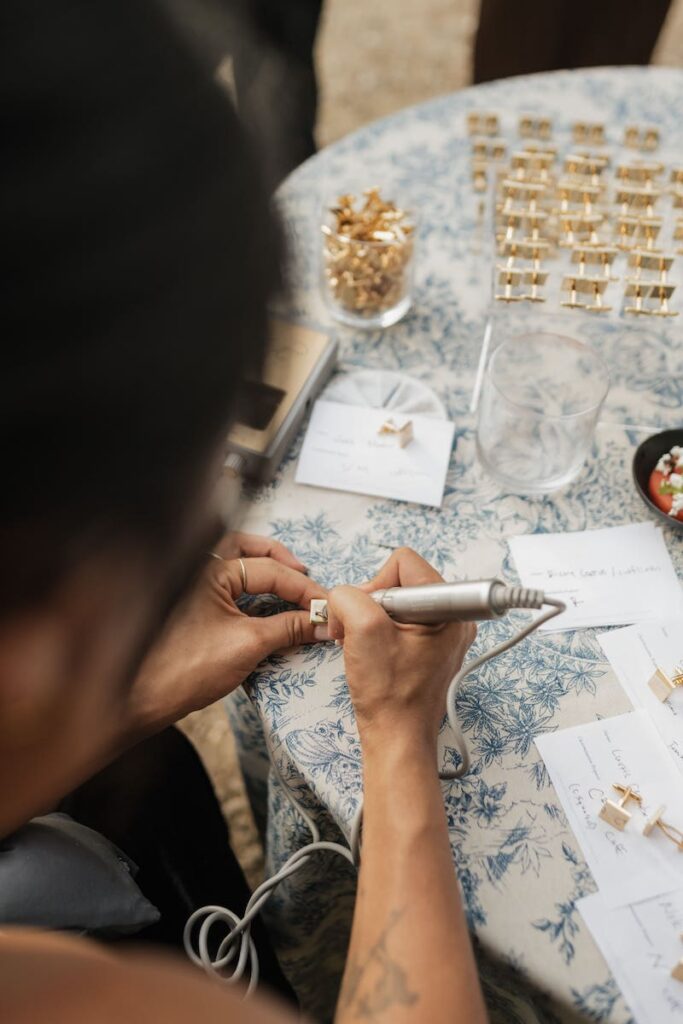
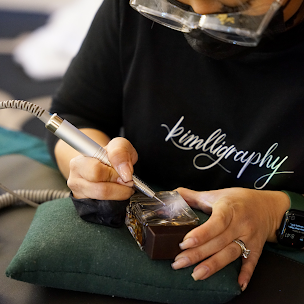
True glass engraving (as used by Carla Schall in live engraving events for luxury brands) uses a rotary or pneumatic engraving tool rather than ink and produces permanent, deeply textured marks that are categorically different from painted calligraphy.
For ink-based glass calligraphy that requires permanence, any painted marks must be heat-set (per the paint manufacturer’s instructions) or coated with a compatible sealant to prevent chipping and peeling over time.
Best Inks for Metal Surfaces
Metal engraving is distinct from ink-based calligraphy on metal, but ink-written calligraphy on metal surfaces has legitimate applications in event signage, custom gift personalization, and decorative arts.
Enamel paint markers are the most reliable tool for writing on metal surfaces. Molotow Chrome Markers and Sakura Paint Markers both provide good adhesion on clean metal surfaces.
For fine pointed pen calligraphy on metal, the surface must first be thoroughly degreased (isopropyl alcohol is standard), primed with a compatible adhesion primer if long-term permanence is required, and written using oil-based paint thinned appropriately for nib application.
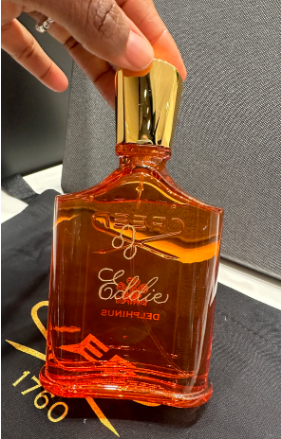
Professionals working in luxury gift personalization, including live engraving on perfume bottles and wine glasses, typically use engraving tools rather than ink for metal surfaces because ink adhesion without mechanical bite is inherently less durable.
Best Inks for Leather
Leather calligraphy is a specialty application used in personalized journal covers, handbag personalization, bespoke goods, and luxury gift customization.
Angelus Leather Paint thinned to a fluid consistency can be applied with a dip pen nib or fine brush to create permanent, flexible marks on smooth leather. It bonds to the leather surface without cracking when the leather flexes, which is the key durability requirement.
For embossed or tooled leather effects, dye-based inks like Fiebings Leather Dye can be applied with a fine brush and will absorb into the leather fiber for a permanent, deep-penetrating color.
Best Inks for Fabric
Fabric calligraphy is used in wedding dress personalization, custom clothing, textile art, and ceremonial items like baptism robes or wedding handkerchiefs.
Jacquard Dye-Na-Flow is a fluid textile paint that flows through a fine nib with excellent consistency and produces soft, non-stiff marks on fabric when heat-set with an iron. It comes in a wide color range and is widely used by textile artists and calligraphers working on fabric surfaces.
Tulip Fashion Glitter and other dimensional fabric paints are used for decorative rather than fine calligraphic work on fabric, as their viscosity is typically too high for fine pointed pen use.
Building a Multi-Surface Ink Collection
For calligraphers who work across multiple surfaces, a practical multi-surface ink collection includes: two black paper inks (sumi for everyday work, iron gall for warm-tone formal work), one professional white ink, one set of gouache in primary colors, one chalk marker set for glass and non-porous event surfaces, and one enamel paint marker set for metal and permanent non-paper work.
This collection covers the vast majority of professional commissions and project requirements without the redundancy of collecting large numbers of similar inks in slightly different formulations.
Understanding the full range of calligraphy costs associated with professional-quality materials helps calligraphers and clients alike understand why specialty surface work carries premium pricing relative to standard paper calligraphy.
FAQ
Fountain pen ink is too thin to load a dip nib properly. It will flow off the nib before you can apply it to the surface and will not produce the line quality or opacity that calligraphy dip inks are formulated for. Use inks specifically formulated for dip pen use.
Standard sumi and iron gall inks are permanent once dry and do not require sealing on paper for archival purposes. However, for pieces that will be handled frequently (place cards, gift tags, stationery) a light spray of fixative extends the surface durability of the ink.
Dr. Ph. Martin’s Iridescent Copperplate Gold and Finetec Inka Gold (in pan form, mixed with water) are both professional-grade gold inks with excellent luster and flow properties. Metallic inks require more frequent nib cleaning than black inks due to their particle suspension.
Mixing inks from the same base chemistry (all water-based, for example) is generally safe for color blending. Mixing inks from different base chemistries (water-based with shellac-based, for example) can cause clogging, precipitation, or unexpected chemical reactions. Always test small quantities before using a mixed ink on final work.
Store ink bottles upright in a cool, dark location away from direct sunlight. Cap bottles immediately after use to prevent evaporation and contamination. Most quality calligraphy inks have a shelf life of two to five years when stored properly. If ink develops a film, debris, or strong odor, it should be replaced.
See how Carla uses specialist inks across paper, glass, and metal in live engraving and event calligraphy that leaves guests speechless. Explore Carla’s work at carlaschall.com