

Planning a wedding involves hundreds of decisions, and most couples quickly discover that the timeline governing each vendor relationship is just as important as the vendor they choose.
Wedding calligraphy is one of the most misunderstood elements in that timeline. It looks like a decorative add-on from the outside, something you can circle back to after the big decisions are locked. In reality, calligraphy is a production-intensive process that connects directly to your invitation mailing schedule, your venue setup logistics, and your day-of guest experience. Get the timeline wrong and you are paying rush fees, receiving pieces that have not been properly proofed, or worse, arriving at your venue to discover something is missing. This guide gives you the exact windows for every decision, so none of that happens to you.
Why the Wedding Calligraphy Timeline Is More Complex Than Most Couples Expect
Most people assume calligraphy is a quick job. A professional sits down, writes beautifully, and the pieces are done. The reality is that a full wedding calligraphy suite for 150 guests can involve over 300 individual handwritten pieces when you count outer envelopes, inner envelopes, place cards, escort cards, menu cards, and table numbers.
Each of those pieces is written by hand, one at a time. There is no batch printing, no copy-paste function, and no correcting a mistake by hitting undo. If a name is misspelled on envelope 112, it goes in the waste pile and is rewritten from scratch. This is the beautiful inefficiency that makes hand calligraphy meaningful, and it is also why the timeline requires more lead time than most couples initially budget for.
Understanding the timeline also protects your budget. Rush fees in the calligraphy industry typically add 20 to 50 percent to the base cost of any order. A couple who books 14 months out and follows a clear production schedule almost never pays a rush fee. A couple who realizes they forgot to address their invitation envelopes six weeks before their wedding date typically pays significantly more for the same quality of work.
What a Complete Wedding Calligraphy Suite Actually Includes
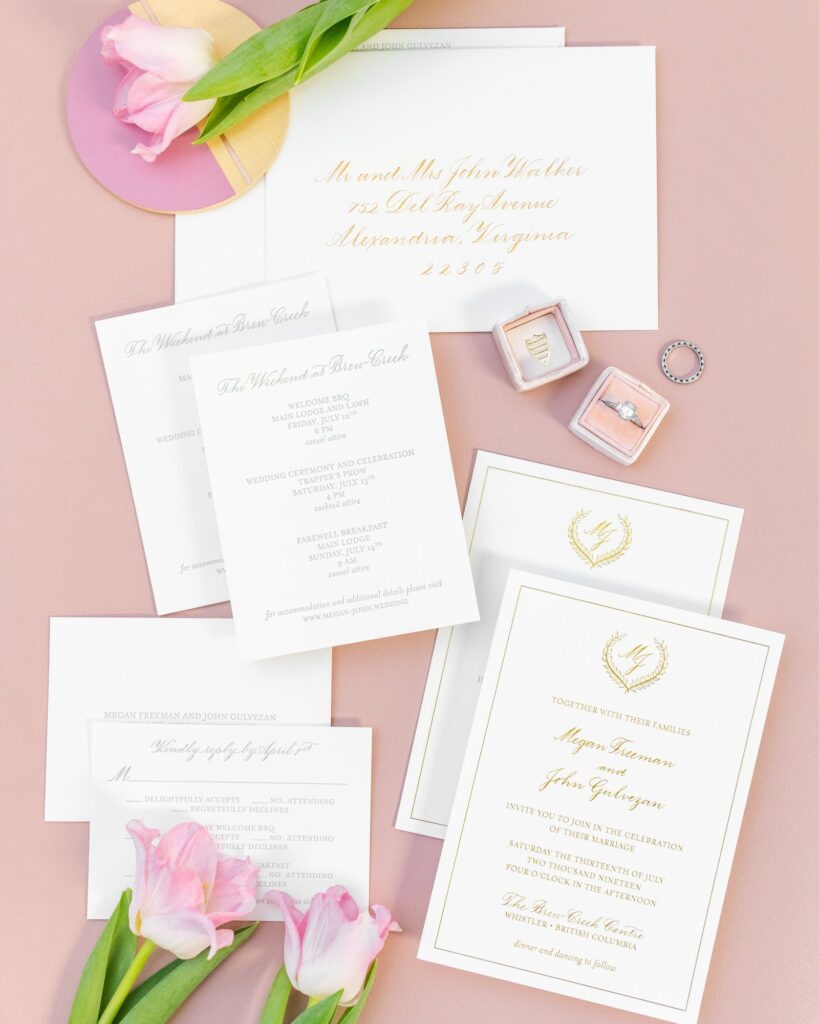
Before you can build a timeline, you need to know what pieces are part of your suite. A full calligraphy suite for a traditional wedding typically includes save-the-date outer envelopes, invitation outer envelopes, invitation inner envelopes, response card envelopes, place cards, escort cards, menu cards, table numbers, ceremony programs with calligraphy accents, vow books for the couple, a hand-lettered seating chart, and a welcome sign.
Not every couple needs every piece. Many couples prioritize the highest-visibility items, the welcome sign, envelope addressing, and place cards, and opt for printed alternatives for supplementary pieces like table numbers and menu cards.
Working out your priority list before your first calligrapher consultation allows you to get an accurate quote immediately and build a timeline based on your actual scope rather than a hypothetical full suite. The save money on wedding calligraphy guide helps couples identify which pieces deliver the highest visual impact per dollar invested, which is a useful framework for making those early prioritization decisions.
12 to 14 Months Before Your Wedding: Book Your Calligrapher
This is the single most important window in the entire timeline, and it is the one most couples underestimate. Experienced wedding calligraphers in Florida, particularly those working across Miami, Palm Beach, and Fort Lauderdale, fill their calendars a full year in advance for peak wedding season dates between October and April.
Booking this far in advance does not mean you need every detail finalized. At this stage, you are securing your date with a signed contract and a holding deposit. The details of your suite, the specific pieces, the script style, the ink color, and the paper type, can be worked out in the months that follow. What matters now is that your preferred calligrapher’s calendar reflects your wedding date as taken.
What to Prioritize When Evaluating Calligraphers at This Stage
Your primary task in this early window is finding a calligrapher whose aesthetic aligns with your wedding vision. This requires looking at their portfolio carefully, not just for beauty, but for stylistic range. A calligrapher who only works in one script style may not be the right fit if your wedding aesthetic calls for something different.
Ask to see examples that are similar to what you envision for your own suite. Ask about their experience with your paper type, whether you are planning to use a specific stationery designer’s papers, or with your venue’s specific display requirements for large-format pieces like welcome signs.
The guide to choosing the right calligraphy style for your wedding is an excellent resource to review before your first consultations so you can communicate your preferences clearly and evaluate each calligrapher’s response to your specific direction.
Questions to Ask During Your Initial Booking Consultation
You should ask about the calligrapher’s production process, specifically how they handle corrections, what their policy is on address errors, and how proofs are managed. Ask about their communication style and how quickly they typically respond to client messages during the production process.
You should also ask about their experience with your specific wedding venue if it is a prominent local venue. A calligrapher who has worked there before will understand the welcome sign mounting requirements, the setup logistics, and any venue-specific conditions that might affect their production planning.
9 to 10 Months Before: Coordinate with Your Stationery Designer
Most couples who use a professional calligrapher for envelope addressing also work with a stationery designer for their printed invitation suite. These two vendors need to be introduced to each other early in the process because their work is directly interdependent.
Your calligrapher will be addressing the envelopes your stationery designer prints. This means the envelope paper type, the color, the size, and the surface finish all need to be compatible with the ink and technique your calligrapher uses. A glossy envelope surface, for example, can cause certain ink types to bead or smear, which requires a different ink formulation than what works on a matte cotton paper.
Introducing your calligrapher and stationery designer at the nine to ten month mark gives both vendors time to test materials together and resolve any compatibility issues before production begins. It also allows your stationery designer to provide the correct number of envelopes, including the standard buffer of 15 to 20 percent above your guest count for addressing corrections and replacements.
Locking Your Guest Count Before Calligraphy Quotes Can Be Finalized
Your calligrapher cannot give you a final quote for envelope addressing until you have a reasonably stable guest count. Pricing for addressing work is calculated per piece, which means every fluctuation in your guest list changes your total cost.
Most calligraphers are comfortable working with an approximate count at the booking stage and will finalize the quote once the guest list stabilizes. However, significant increases in guest count after the production timeline has been agreed upon can affect the calligrapher’s scheduling and may require renegotiation of delivery dates.
Target having a stable guest count no later than the eight-month mark. This gives both you and your calligrapher sufficient time to finalize the order scope, confirm pricing, and begin production at the appropriate time. The calligraphy cost per envelope guide explains exactly how per-piece pricing works and what factors influence the final rate.
7 to 8 Months Before: Finalize Your Script Style and Ink Color
Seven to eight months before your wedding is the time to make your calligraphy style and color decisions final. This is not a decision to leave open until closer to the event because your calligrapher needs to prepare materials, confirm ink availability, and in some cases, practice and refine a specific script style if your request involves something outside their most frequently used repertoire.
Ink color selection in particular benefits from advance planning. Custom ink mixing, which is sometimes required to achieve a specific branded color or to match a floral palette exactly, requires testing and curing time. An ink that photographs beautifully in the studio but bleeds on your specific envelope paper needs to be caught and corrected with enough runway to source an alternative.
Reviewing Style Options Against Your Overall Wedding Aesthetic
Your calligraphy script style should feel like a natural extension of your overall wedding design. A heavily flourished traditional script on a minimalist modern wedding invitation reads as a stylistic conflict. A clean contemporary pointed pen style on a romantic garden wedding suite might lack the organic warmth the setting calls for.
Bring your full mood board to this style consultation, including venue photographs, floral design references, and your stationery designer’s invitation samples if they are already finalized. The 2025 wedding calligraphy trends resource shows what script directions are resonating most strongly in the current Florida market, which can be a useful calibration point even if you ultimately choose something more classic.
6 Months Before: Submit Your Address List and Request a Proof
Six months before your wedding date is when the practical production work begins in earnest. Your calligrapher will need your finalized address list in a formatted spreadsheet, and this is also the appropriate time to request a handwriting proof for your approval before the full run begins.
Your address list should be submitted in a clean spreadsheet with each field in a separate column: title, first name, last name, address line one, address line two, city, state, and zip code. Any special formatting notes, such as how to handle “Doctor and Mrs.” versus “The Doctors,” should be included in a notes column alongside the relevant rows.
The proof is one of the most important quality control steps in the entire calligraphy production process from ink to envelope. Do not rush the proof review. Take time to verify spelling on every name, confirm the addressing format you have agreed upon, check the ink color against your envelope in the actual lighting conditions of your home rather than on a screen, and confirm the script style matches your expectations.
How to Review a Calligraphy Proof Correctly
Most couples receive their proof as a high-resolution photograph of one or two completed envelopes. When reviewing, zoom in enough to read every character clearly. Check that honorifics are handled consistently with your preferences. Confirm that long names are not crowded and that line breaks fall in logical places.
If you have corrections, communicate them clearly and specifically. “The ink looks too dark” is difficult to act on. “The ink reads as dark charcoal rather than the warm black we discussed; can we see it one shade lighter?” is actionable. Your calligrapher is a skilled professional who will respond well to specific, clear feedback and less well to vague impressions.
One round of revisions is standard in most calligrapher contracts. If you have significant changes after the first proof, confirm whether additional proof rounds incur a cost before requesting another.
4 to 5 Months Before: Receive and Review Your Invitation Envelopes
Production of a standard envelope addressing order of 150 pieces typically takes two to four weeks, not counting delivery time. At four to five months before your wedding date, your addressed invitation envelopes should be in your hands, reviewed, and approved.
This delivery window is important because your invitations need to be mailed eight to twelve weeks before your wedding date for domestic guests and ten to fourteen weeks for international guests. Having addressed envelopes in hand four to five months out gives you time to stuff, seal, add postage, and mail without rushing.
Conducting Your Receiving Quality Check
When your envelopes arrive, open the package carefully and set them all out where you can inspect each one individually. Work through them systematically against your original address list. Check every name spelling, verify each address line, and look for any ink inconsistencies like skipped strokes, ink bleed, or smearing that might have occurred during shipping.
Most calligraphers provide a small number of extra envelopes in case any are lost or damaged in mailing, but replacement envelopes for significant errors should be discussed in advance. Know your calligrapher’s policy before the box arrives so you can act quickly if corrections are needed.
3 Months Before: Commission All Day-Of Paper Pieces
Day-of calligraphy pieces including place cards, escort cards, table numbers, menu cards, and any printed program inserts with calligraphy elements have shorter production lead times than envelope runs but still require three to five weeks of studio time plus delivery.
Three months before your wedding is the right moment to confirm your seating approach and order your day-of pieces. Many couples still have some flexibility in their seating at this point, which is fine, but the calligraphy order should be structured around a reasonably stable version of your guest list and seating plan.
The Seating Chart Decision: Hand Calligraphy or Printed
One of the most impactful day-of decisions you will make is whether your seating chart will be hand-calligraphed or printed with calligraphy-style fonts. The difference in visual impact and guest experience is significant.
A hand-lettered seating chart is a statement piece that reads as a work of art. Guests pause in front of it, photograph it, and interact with it as an aesthetic object rather than just a functional guide. It also eliminates the need for individual escort cards, which simplifies your welcome table logistics considerably.
The comprehensive comparison of calligraphy seating charts versus printed alternatives covers the cost differences, logistical implications, and visual impact of each approach, which gives you the full picture for making this decision confidently.
6 to 8 Weeks Before: Finalize Your Welcome Sign and Vow Books
Welcome signs and vow books are typically the last major calligraphy pieces to be commissioned because their content depends on decisions that are often finalized late in the planning process.
Your welcome sign wording should be confirmed and submitted to your calligrapher no later than eight weeks before your wedding. This allows two to three weeks for production, one week for shipping and delivery, and two to three weeks of buffer for any corrections or last-minute logistics issues.
Vow books, if you are having them custom-made, should also be commissioned during this window. Many couples write their vows in the final weeks before the wedding, but the physical books themselves can be ordered as blank or lightly designed pieces and personalized with your names, date, and a meaningful phrase on the cover while the interior remains ready to receive handwritten vows.
What Welcome Sign Production Actually Involves
A large-format welcome sign on wood, acrylic, or mirror is not a piece that can be rushed without compromising quality. The calligrapher must transfer the approved wording to the final surface by hand, allow appropriate drying time for the ink or paint, apply any finishing treatments, and prepare the piece for safe shipping or delivery.
Rush welcome signs, commissioned within four weeks of a wedding date, often carry significant additional fees and may not benefit from the same level of care as pieces produced within a standard timeline. Building your welcome sign into your calligraphy budget from the beginning and commissioning it at eight weeks out is the simplest way to ensure you receive the quality this visible piece deserves.
2 to 3 Weeks Before: Confirm Final Delivery of All Pieces
Two to three weeks before your wedding date, every calligraphy piece should either be in your hands or confirmed for delivery with a specific tracking number and expected arrival date. This is not a detail to leave for the final week.
At this stage, do a complete inventory of everything you have ordered. Pull out your original contract or order confirmation and check each item against what you have physically received. Place cards in total guest count, welcome sign confirmed, table numbers covering every table, menu cards in full quantity, vow books for both partners, and any other pieces in your suite.
If anything is missing or damaged, contacting your calligrapher two to three weeks before the wedding still gives you time to resolve the issue without crisis management. The same issue discovered three days before the wedding is an entirely different conversation.
Storing and Transporting Calligraphy Pieces Before the Wedding
Calligraphy ink is permanent once cured, but the papers themselves can be damaged by moisture, heat, or pressure during storage and transport. Store flat pieces like place cards and menu cards in a dry, climate-controlled space, ideally in the protective packaging they arrived in.
Large pieces like welcome signs and seating charts should be stored flat or gently rolled and wrapped, never folded. If your calligrapher has included protective tissue or foam padding in the packaging, keep that protection in place until setup day.
The Week of Your Wedding: Setup and Installation Coordination
In the final week, your task is coordinating the installation of calligraphy pieces with your venue coordinator and wedding planner. Most calligraphy pieces can be set up the day before the wedding or the morning of the event. Confirm setup timing with both your planner and your venue to ensure everything is in place before guests arrive.
Some calligraphers offer delivery and installation services for larger pieces, which removes this coordination task from your plate entirely. If this service is available and within your budget, it is worth considering for complex multi-piece suites or large-format statement pieces.
The real Florida weddings calligraphy portfolio shows how properly planned and installed calligraphy suites come together on wedding day, which can serve as both inspiration and a practical reference for what your finished suite should look like when everything is in place.
Building Your Personal Production Calendar
Every wedding is different, and your timeline will need to flex around your specific venue, guest count, stationery vendor, and the scope of your calligraphy suite. Use the windows above as your structural framework, then work backward from your wedding date to set firm internal deadlines for each milestone.
Share this calendar with your wedding planner if you have one. Calligraphy deadlines that are invisible to your planner can create conflicts with other vendor scheduling, particularly for stationery designers who need to deliver papers to your calligrapher on a specific date.
The most important thing you can do for your wedding calligraphy timeline is begin it early, communicate clearly, and trust your calligrapher’s professional guidance on what is realistic within your chosen windows. The elegant calligraphy ideas for weddings resource will help you arrive at your planning process with a clear creative vision that makes every production conversation more efficient and every final piece more meaningful.
Frequently Asked Questions
For peak season dates between October and April, booking 12 to 14 months in advance is strongly recommended. Top-tier calligraphers in Miami, Palm Beach, and Fort Lauderdale fill their calendars quickly for the most sought-after dates. A signed contract and deposit hold your date while you finalize all other details in the months that follow.
In most cases, yes. Additions are typically possible as long as they are requested with adequate production lead time. Pieces added close to the event date may incur rush fees. Confirm the addition policy in your booking contract before signing so you understand the parameters in advance.
A full outer and inner envelope run for 150 guests typically takes two to four weeks of studio production time, not including shipping. Plan to submit your finalized address list at least six to eight weeks before your desired mailing date to allow time for production plus one round of proof review.
Most calligraphers prefer a Google Sheet or Excel spreadsheet with each field in a separate column: title, first name, last name, street address, city, state, and zip code. A notes column for special formatting instructions is also helpful. Ask your calligrapher for their specific preferred template during your consultation.
Errors caught at the proof stage are corrected at no additional charge as part of the standard proofing process. Report corrections clearly and specifically in writing rather than verbally to create a clear record. One round of revisions is typically included; additional revision rounds may be subject to fees depending on your contract terms.
Contact Carla Schall Designs today to check availability for your wedding date and receive a personalized production schedule for your complete calligraphy suite. The best dates fill fast, and starting early is the single most powerful thing you can do for your calligraphy experience.