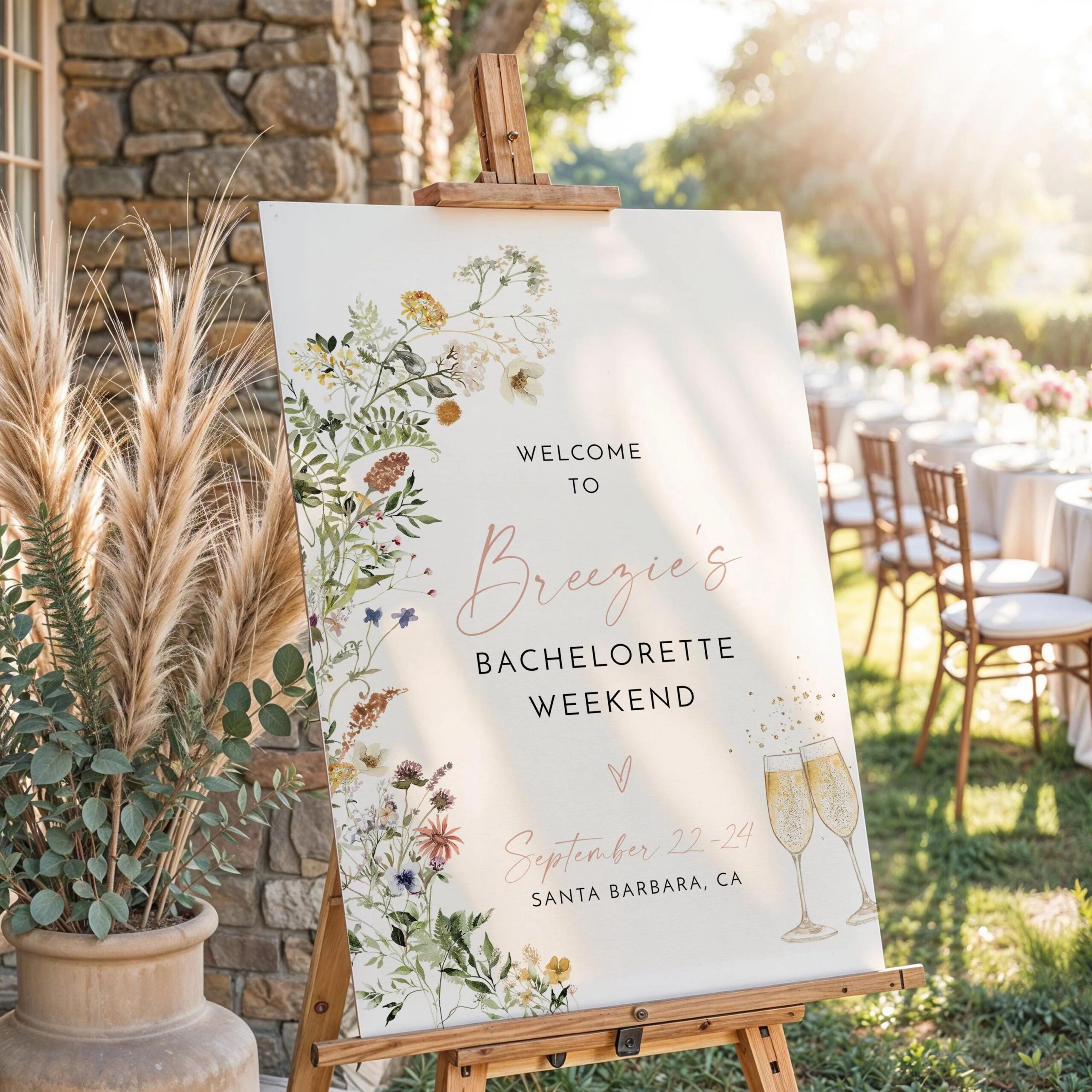


The wedding welcome sign is the first thing your guests encounter before a single flower arrangement is visible, before the ceremony music begins, and before a family member moves to usher them to their seat.
That first impression matters more than most couples realize when they are deep in the details of floral choices and seating charts. A beautifully hand-lettered welcome sign does not just tell guests where they are. It tells them what kind of celebration they are about to experience. It establishes the emotional register of your wedding day before a word is spoken. Getting the wording right and choosing the right calligraphy style to bring those words to life is one of the most rewarding creative decisions in the entire planning process.
What Your Wedding Welcome Sign Is Actually Doing
Before choosing words or script styles, it helps to understand the function of a welcome sign in context. Functionally, it confirms to guests that they are at the right venue, communicates the couple’s names and wedding date, and in some cases, provides directional or seating guidance.
Emotionally, it sets the tone. A sign with a formal classical script and traditional wording tells guests they are stepping into a celebration that honors convention and elegance. A sign with a warm, flowing modern script and a funny inside-joke line tells them this is going to be a celebration of personality.
The most effective welcome signs deliver both functions simultaneously. They confirm logistics while creating an emotional welcome that feels personal and intentional. As explored in the handwritten comeback in the digital age article, hand-lettered pieces carry an emotional authenticity that printed alternatives simply cannot replicate, and this is precisely why the welcome sign has become one of the most photographed elements of any modern wedding.
Why Calligraphy Elevates Welcome Sign Wording Beyond the Words Themselves
Identical wording printed in a digital font and hand-lettered by a skilled calligrapher produces two entirely different guest experiences. The handwritten version has visual rhythm, subtle variation in letterform, and a quality of presence that signals human effort and artistic intention.
When guests see a hand-calligraphed welcome sign, they often pause before reading it. The visual texture draws the eye before the words register. That pause is the emotional preparation for the experience ahead, and it cannot be manufactured by any printed alternative regardless of font quality or paper grade.
Classic Wedding Welcome Sign Wording That Always Works
Classic wording is built around simplicity, formality, and timelessness. It suits cathedral ceremonies, estate venues, grand hotel ballrooms, and any wedding where the aesthetic leans toward traditional elegance.
Classic Option 1: The Essential Welcome
Welcome Mr. and Mrs. [Last Name] [Day, Month Date, Year]
This is the most stripped-back version and works beautifully when the calligraphy itself is the visual statement. The minimal wording gives the script maximum room to breathe.
Classic Option 2: The Invitation Echo
Please Join Us in Celebrating The Marriage of [Full Name] and [Full Name] [Date] | [Venue City]
This mirrors the formal language of a traditional invitation suite and creates tonal consistency from the first piece your guests received months earlier to the first sign they see on your wedding day.
Classic Option 3: The Named Welcome
Welcome to the Wedding of [First Name] and [First Name] [Date]
Warm enough to feel personal, formal enough to suit most traditional venues. This version works across the broadest range of aesthetics because it positions the couple’s names as the hero without committing to a specific stylistic register.
Script Styles That Suit Classic Wording
Copperplate and Spencerian are the natural pairings for classic welcome sign wording. Both scripts carry historical weight, formal structure, and a precision that signals respect for tradition.
The guide to choosing the right calligraphy style for your wedding covers the visual characteristics of each style in detail, which helps couples identify which script language aligns with their venue and invitation design before they ever see a physical sample.
Modern and Conversational Welcome Sign Wording
Contemporary weddings frequently favor wording that reflects the couple’s personality more directly. This approach moves away from formal templates and toward language that guests who know the couple will immediately recognize as authentic.
Modern Option 1: The Direct Welcome
We Are So Glad You Are Here [First Name] and [First Name] [Date] | [City or Venue Name]
The shift from the third-person “welcome to our wedding” to the more direct “we are so glad you are here” creates an immediate warmth that feels less ceremonial and more genuinely personal.
Modern Option 2: The Personality Statement
After All This Time, Finally [First Name] and [First Name] Are Getting Married [Date]
This wording works brilliantly for couples who have been together for a long time or who have a playful relationship with the idea of finally making it official. Guests who know the story laugh when they read it. Guests who do not know the story are intrigued.
Modern Option 3: The Location Anchor
You Have Made It Welcome to [City] for the Wedding of [First Name] and [First Name]
This approach is especially effective for destination weddings where many guests have traveled a meaningful distance. Acknowledging the travel in the wording makes guests feel seen and appreciated immediately upon arrival.
Modern Option 4: The Simple Statement of Joy
Love Wins [First Name] and [First Name] [Date]
Short, punchy, and visually dynamic in a bold modern script. This version works best when the calligraphy itself is highly expressive because the minimal wording places maximum emphasis on the artistry of the lettering.
Script Styles That Suit Modern Wording
Modern pointed pen scripts, bounce lettering, and organic flourished styles pair naturally with contemporary wording. These scripts have a livelier, less rigid quality than classical styles, which reinforces the personality-forward tone of modern welcome sign wording.
The 2025 wedding calligraphy trends guide identifies the specific modern styles gaining the most traction in the current market, which is a useful reference for couples who want their sign to feel current without becoming trendy in a way that dates quickly.
Meaningful Quotes and Phrases That Work on Welcome Signs
Beyond the structural wording options above, many couples choose to anchor their welcome sign with a quote, a literary reference, or a line that holds personal meaning for their relationship.
The most effective quotes for welcome signs share certain qualities: they are short enough to read at a glance, they hold universal emotional resonance rather than requiring context to understand, and they feel true to the couple without being so inside-reference that they confuse the broader guest group.
Quotes That Photograph Beautifully in Calligraphy:
“And so the adventure begins” This line works for any couple because it positions the wedding as a beginning rather than a culmination. It is forward-looking and optimistic without being sentimental.
“All you need is love” A cultural touchstone that is widely recognized, instantly warm, and visually strong in calligraphy because of its natural rhythm.
“To love and to be loved is everything” More literary in tone, this suits couples whose relationship is built around depth and thoughtfulness.
“Happily ever after starts here” Playful and celebratory, this works well for couples who have a warm, lighthearted relationship with each other and with their guests.
“Two are better than one” A phrase that draws from shared cultural and spiritual tradition without being denomination-specific, making it accessible across different guest backgrounds.
Avoiding Welcome Sign Quotes That Feel Generic
The challenge with popular quotes is that they are popular precisely because they have been widely used. If your welcome sign quote appears on ten other welcome signs in the same wedding photography community this year, it loses the quality of personal authenticity that makes a welcome sign genuinely memorable.
The solution is not to avoid quotes entirely but to choose language that connects specifically to your relationship. A line from the song that played at your first date, a paraphrase of something meaningful from your relationship, or a phrase from a book that is central to your shared history will always feel more authentic than the most beautiful generic quote.
Seasonal and Venue-Specific Wording That Creates Sense of Place
One of the most underused strategies for welcome sign wording is drawing directly from the setting and season of your celebration. Venue-specific wording creates an immediate sense of place that guests experience as intentional, creative, and uniquely yours.
For a Beach or Coastal Wedding: “Seas the Day — Welcome to Our Wedding” “Love is Better by the Water” “The Best Views Come After the Hardest Climbs — Thank You for Making the Journey”
For a Garden or Outdoor Botanical Wedding: “In Full Bloom — Welcome” “Love Grows Here — [Names] | [Date]” “Gather Here in the Garden”
For a Vineyard or Winery Wedding: “Where Good Wine and Great Love Bring Everyone Together” “Harvest Season — Welcome to Our Wedding” “Love Ages Well — [Names] | [Date]”
For a Ballroom or Estate Wedding: “Welcome to Our Evening” “This Night Belongs to Everyone Here — Thank You for Coming” “Grand Occasions Begin with Grand People — Welcome”
For a Destination Wedding: “You Traveled Far — We Are Glad You Did” “Somewhere Beautiful for Something Even Better — Welcome”
These venue-specific approaches make your welcome sign feel inseparable from its setting, which elevates the sense of intention behind every element of your wedding design.
Bilingual and Multicultural Welcome Sign Wording
Florida’s multicultural wedding landscape makes bilingual welcome signs both increasingly common and deeply meaningful for couples who are celebrating across two cultural traditions.
A thoughtful bilingual approach places both languages in visual dialogue rather than simply stacking one below the other. The primary language of the celebration typically takes the hero position in a larger, more prominent script, while the secondary language appears beneath in a complementary but visually distinct treatment.
Bilingual Wording Approaches:
English and Spanish: Welcome | Bienvenidos [Names] | [Date]
English and Portuguese: Welcome to Our Wedding | Bem-vindos ao Nosso Casamento
English and Hebrew: Welcome | ברוכים הבאים
The handwritten magic that makes weddings feel genuinely personal explores how multilingual calligraphy in particular carries a meaning that transcends the specific words chosen, creating a visual bridge between two cultural traditions that printed text rarely achieves with the same impact.
Practical Wording Structures for Different Sign Formats
Welcome signs come in many physical formats, and the wording structure that works on an eight-foot wood plank is different from the one that works on a 24-inch acrylic square. Understanding how wording scales with sign format helps you develop the right word count and line structure from the beginning.
Large Format Signs (5 feet and above): These signs can accommodate more words and more structural complexity. Three to four lines of text create a comfortable hierarchy. The headline element should be in a large, bold script, with secondary information in a lighter complementary style beneath.
Medium Format Signs (2 to 4 feet): Two to three lines work best. A hero word or phrase plus names and date is the most effective structure. Too many lines on a medium format sign creates visual crowding.
Small Format Signs (under 2 feet): One to two lines maximum. Names and date only, or a short phrase and a name. At this scale, the calligraphy artistry does all the communicative work and the words must be minimal.
Working with Your Calligrapher on Layout and Wording Balance
Your calligrapher is not just executing your words; they are designing the visual presentation of those words on the specific surface of your sign. This means they think in terms of line length balance, weight hierarchy between headline and body text, and the relationship between the script style and the available surface area.
Bring your wording ideas to your consultation as a starting point, not as a finished brief. Be open to layout suggestions from your calligrapher. A professional who has designed dozens of welcome signs will often see a more visually effective arrangement of your chosen words than you would arrive at independently.
The is calligraphy worth it for your wedding guide addresses this collaborative dimension of working with a professional directly, helping couples understand what they are investing in beyond the physical piece.
Common Welcome Sign Wording Mistakes to Avoid
Including too much information on a welcome sign is the most common mistake. A welcome sign is not a program insert. It is not a schedule of the day’s events. It is not a list of vendor credits or a family acknowledgment. It has one job: make guests feel welcome and set the emotional tone.
Keep your wording focused on identity (who is getting married), occasion (the wedding), and warmth (the welcome). Everything else belongs on separate signage designed specifically for informational purposes.
Choosing wording that requires context to understand is another frequent issue. A personal inside joke that is hilarious to the couple and their three closest friends may read as confusing or alienating to the wider guest group. Your welcome sign greets everyone who attends, including your grandparents, your parents’ colleagues, and your partner’s extended family from out of town. The wording should work for all of them simultaneously.
Overcomplicating the font hierarchy is a mistake that happens when couples try to incorporate too many visual elements. If your welcome sign has five different line styles, three colors, and decorative flourishes competing for attention on every line, it reads as chaotic rather than elegant. Trust your calligrapher to create visual hierarchy using varying script weights and sizes within a cohesive style.
Finalizing Your Wording: A Simple Framework
Start with the non-negotiables: your names and your wedding date. These elements belong on every welcome sign regardless of style, tone, or format.
Then choose one additional element: a tone-setting word or phrase, a meaningful quote, or a venue-specific line. One additional element is almost always enough. The most memorable welcome signs in the world typically use eight to fifteen words total, and the ones that use fewer often make a stronger impression than those that use more.
Write three to five versions of your wording, varying the structure and tone slightly between each version. Bring them all to your calligrapher consultation. A professional will help you identify which option works best for your specific sign format, script style, and overall wedding aesthetic.
Then commit to your choice, submit for your proof approval, and trust the process. The artistry of hand calligraphy will do more for that sign than any additional word you might be tempted to add.
Before you finalize your welcome sign wording, take a look at real Florida weddings calligraphy work for inspiration that is grounded in the specific conditions and aesthetics of the Florida market where your wedding is taking place.
Frequently Asked Questions
Eight to fifteen words is the sweet spot for most welcome sign formats. Shorter wording gives the calligraphy more visual prominence and makes the sign easier to read at a distance. If your wording exceeds twenty words, consider whether some of that information belongs on a separate directional or informational sign instead.
Yes, and this is one of the most personal approaches to welcome sign wording. Keep in mind that extremely well-known lyrics may feel familiar rather than personal. Paraphrasing a lyric that matters deeply to you is often more effective than quoting it directly because it feels more authentically yours.
Modern pointed pen scripts with moderate flourishes maintain excellent legibility at scale. Extremely ornate historical scripts can become difficult to read when scaled up for large outdoor signs. Ask your calligrapher to provide a scaled mockup of your chosen script before approving the final wording.
Yes, some couples commission mixed-media signs that incorporate a printed or hand-painted element alongside hand calligraphy. This is a more complex production request and should be discussed in detail with your calligrapher during the consultation phase to confirm technical feasibility and additional cost.
Your wording should be finalized and approved at least six to eight weeks before your wedding date. This window allows for proof creation, one round of revisions if needed, full production time, and safe delivery with buffer days before setup.
Reach out to Carla Schall Designs for a personalized consultation that covers wording, script selection, sign format, and everything in between. Your welcome sign will be the first thing your guests see — let’s make it extraordinary.