

Choosing a calligraphy style for your wedding is not simply an aesthetic preference. It is a communication decision.
Every script carries a visual personality that signals formality or relaxation, tradition or modernity, intimacy or grandeur, before a single word of the content is read.
Getting the match between your script and your wedding theme right elevates the entire event’s visual coherence. Getting it wrong creates a subtle tension that guests feel even if they never consciously notice it.
This guide helps you identify your wedding’s visual personality and find the calligraphy style that speaks it most fluently.
Why Script Choice Matters More Than Most Couples Realize
When you hold a wedding invitation, the script tells you what kind of event you are about to attend before the words do.
A Copperplate-engraved invitation on thick cream stock communicates formal elegance. A fluid modern brush script on kraft paper communicates relaxed authenticity. A clean italic on translucent vellum communicates contemporary minimalism.
None of these is better than the others in absolute terms. All of them are wrong if they are mismatched to the event they announce.
The core guide to choosing the right calligraphy style for your wedding maps script personalities to event aesthetics in detail, and it is an essential starting point before any calligraphy style decision is finalized.
The Major Wedding Calligraphy Style Categories
Copperplate: The Classic Standard
Copperplate is the historical ancestor of most Western calligraphy traditions, developed in England during the 17th and 18th centuries for correspondence, legal documents, and formal announcements.
Its defining characteristics are a precise oval letterform, a consistent 52-degree slant, strong contrast between thick downstrokes and hairline upstrokes, and small, elegant loops on ascenders and descenders.
At a wedding, Copperplate reads as formally elegant, historically grounded, and ceremonially appropriate.
It works best for: black-tie weddings in formal venues, garden estate weddings, historically inspired or Old Hollywood themes, and any celebration where the couple values timeless tradition over contemporary trend.
It is less well-suited to: casual backyard weddings, bohemian outdoor ceremonies, or highly contemporary minimalist aesthetics where its historical associations feel incongruous.
Spencerian: The Softer Formal
Spencerian script was developed in mid-19th century America as a more practical evolution of Copperplate, reducing the extreme contrast of thick and thin strokes while retaining the elegant slant and oval foundation.
The result is softer and slightly more approachable than classic Copperplate but still firmly in the formal register.
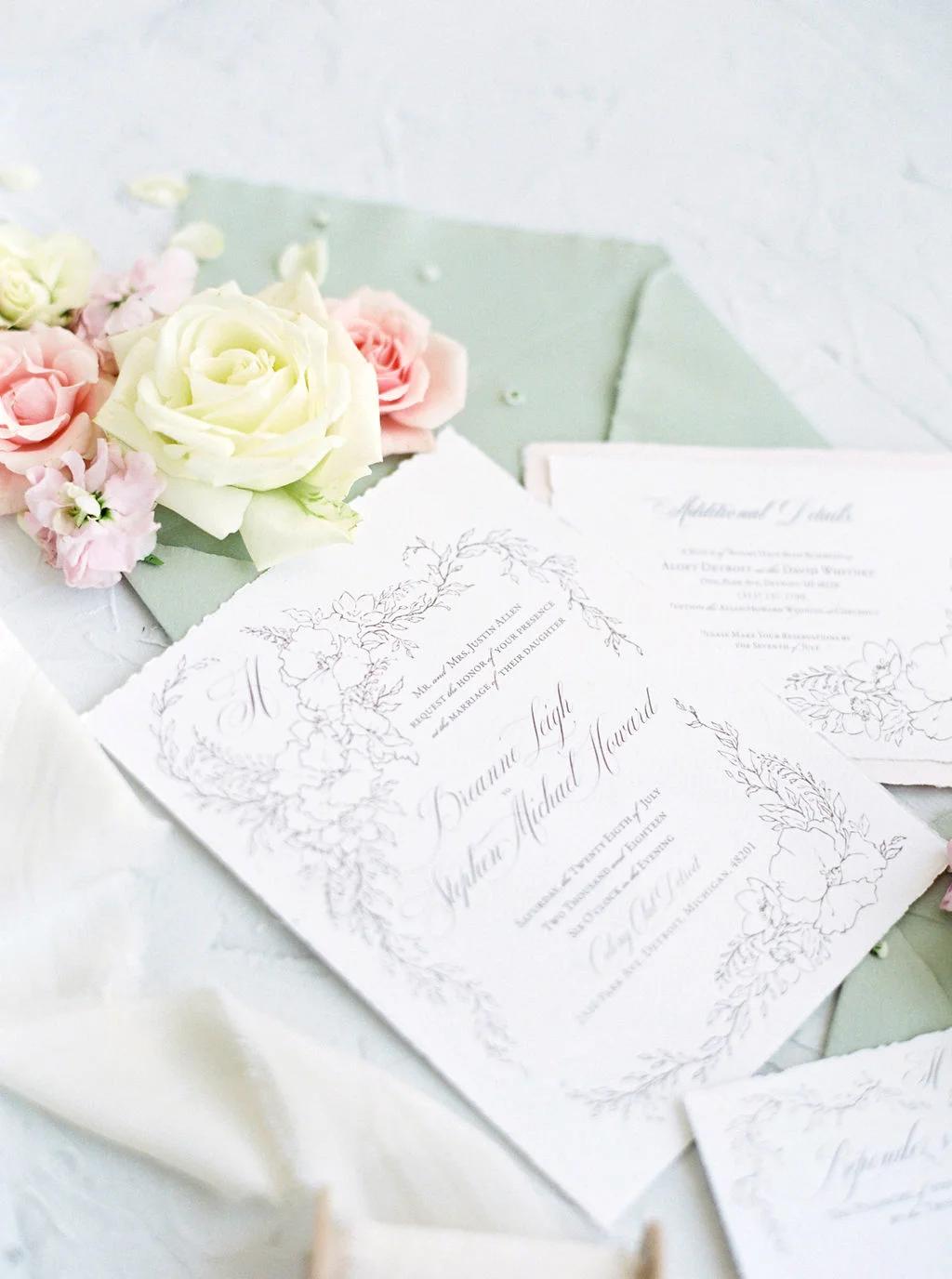
Spencerian works beautifully for couples who want traditional elegance without the most severe formality of Copperplate, and it pairs particularly well with floral wedding aesthetics where the softer letterforms echo the organic quality of the florals.
Modern Calligraphy: The Contemporary Default
Modern calligraphy is the broad category that dominates the current wedding market and has for the past decade.
It is defined by intentional deviation from strict historical rules, allowing for personal style expression within a loose framework of rhythmic stroke patterns.
Modern calligraphy scripts vary enormously in their individual personality, from tightly controlled styles that approach traditional formality to very loose, expressive styles that read almost as artistic lettering.
This variation is both its greatest strength and the source of the most common client confusion: “modern calligraphy” does not describe a single specific look, and reviewing a calligrapher’s portfolio carefully is essential to understanding their particular expression of the style.
Modern calligraphy works for: almost any wedding aesthetic from casual to mid-formal, bohemian celebrations, destination weddings, garden parties, and any couple who wants handwritten warmth without strict historical formality.
Brush Lettering and Brush Script
Brush lettering uses a flexible brush pen or traditional brush to create fluid, expressive letterforms with dramatic variation between thick and thin strokes.
The result is energetic and bold, with a distinctly handcrafted quality that reads as artistic and contemporary.
Brush lettering works best for: casual or relaxed celebrations, coastal weddings, music-themed events, and large-format signage where the dramatic stroke variation can be fully appreciated.
For small-scale applications like escort cards, brush lettering can sacrifice legibility for expressiveness, so it is typically better suited to signage and large display pieces than to individual guest name cards.
Italic Calligraphy
Italic script prioritizes legibility and clean letterform construction over decorative flourish.
It is elegant without being elaborate, and its consistent forward slant and clear letter spacing make it one of the most legible calligraphy styles at any scale.
Italic works particularly well for: weddings with very long guest names, bilingual or multilingual text requirements, or couples who prefer clean contemporary aesthetics over ornate historical styles.
It also pairs exceptionally well with minimalist or Scandinavian-influenced wedding designs where decorative excess would feel out of place.
Matching Script to Your Wedding Theme
For Formal Ballroom or Garden Estate Weddings
Choose Copperplate or Spencerian for primary elements like invitations and welcome signs.
Consider pairing a traditional script for invitation suite calligraphy with a modern script for signage, which creates a visual hierarchy that uses formality where it matters most and warmth where guests interact most closely.
For Bohemian or Garden Outdoor Weddings
Modern calligraphy with organic flourishes and warm ink tones (sepia, warm brown, or deep gold) is the most consistent choice for boho aesthetics.
Brush lettering on natural wood or dried floral installations is also highly effective in this context.
The detailed comparison between boho and classic wedding calligraphy shows how these two approaches play out visually in real Florida wedding contexts.
For Contemporary or Minimalist Weddings
Clean italic or a restrained modern script without heavy flourishing is the right choice here.
Minimalist weddings call for calligraphy that adds texture and warmth without decorative density, so avoiding scripts with elaborate loops and swashes is important to maintain aesthetic coherence.
For Coastal or Tropical Florida Weddings
A relaxed modern script in white or gold ink on dark materials, or in navy or deep green on light materials, is consistently effective for Florida coastal aesthetics.
Brush lettering on driftwood slices or large format boards also works beautifully in this context, where the scale of the setting benefits from bold, expressive letterforms.
The Florida-specific wedding calligraphy guide for 2025 brides covers how local Florida couples are using calligraphy in their specific coastal and tropical celebrations.
Ink Colors and How They Interact with Script Style
Script style and ink color work together to create the final impression.
A formal Copperplate script in matte black on cream card communicates restrained classical elegance.
The same Copperplate in burnished gold ink on deep navy card communicates theatrical grandeur.
A modern organic script in warm sepia on ivory reads as intimate and natural.
The same modern script in white ink on black card reads as contemporary and striking.
Understanding how ink color amplifies or modifies the personality of a script style helps you make more deliberate decisions about the overall visual language of your wedding stationery and signage.
The 2025 and 2026 wedding calligraphy trends note a strong shift toward warm tone palettes, with gold, sepia, and terracotta inks replacing cool blacks and bright whites across the market.
How to Communicate Your Style Preferences to Your Calligrapher
The most effective way to communicate your script preference is through visual references rather than verbal descriptions.
Build a collection of images from your calligrapher’s portfolio, other calligraphers’ feeds, and wedding editorial photographs that show the kind of script quality and personality you are drawn to.
Note what specifically attracts you about each example: is it the flourishing? The slant? The weight of the strokes? The overall density?
This specificity helps your calligrapher understand not just what you like but why you like it, which is the information they need to tailor their own approach toward your aesthetic.
Equally important: note what you do not like. If a particular script is too formal, too loose, too ornate, or too sparse, saying so saves a revision round.
Conclusion
Wedding calligraphy style selection is one of the most rewarding decisions in the planning process when it is approached thoughtfully.
The right script for your wedding communicates something true about who you are as a couple and what kind of celebration you are creating, before a single guest reads a word.
Whether you choose the timeless precision of Copperplate, the warm expressiveness of modern script, or the bold energy of brush lettering, the most important thing is that the style you choose feels genuinely like yours.
Browse Carla’s wedding calligraphy portfolio — book a style consultation → Contact Carla Schall
FAQ
Modern calligraphy in its various expressive forms remains the dominant style in the current market. Within this broad category, organic scripts with natural flourishes and warm ink tones are the most frequently requested for 2026 Florida weddings.
Copperplate is most appropriate for formal or traditional weddings in elegant venues. Its historical associations make it feel slightly incongruous at casual, bohemian, or contemporary celebrations where a more relaxed modern script would be a better aesthetic fit.
Yes, and many calligraphers actively recommend this approach. A traditional script for the formal invitation suite paired with a more expressive modern script for signage creates a visual hierarchy that uses each style where it serves the purpose best.
Review their portfolio carefully and specifically look for examples of the script style you want at the scale and on the material type you are planning to use. A calligrapher who excels at large-format signage does not automatically excel at small-scale escort card calligraphy.
Significantly, yes. The same script in matte black reads as more formal than the same script in warm sepia or soft gold. Ink color is a powerful tool for calibrating the overall tone of your calligraphy aesthetic and should be decided in collaboration with your calligrapher rather than as an afterthought.