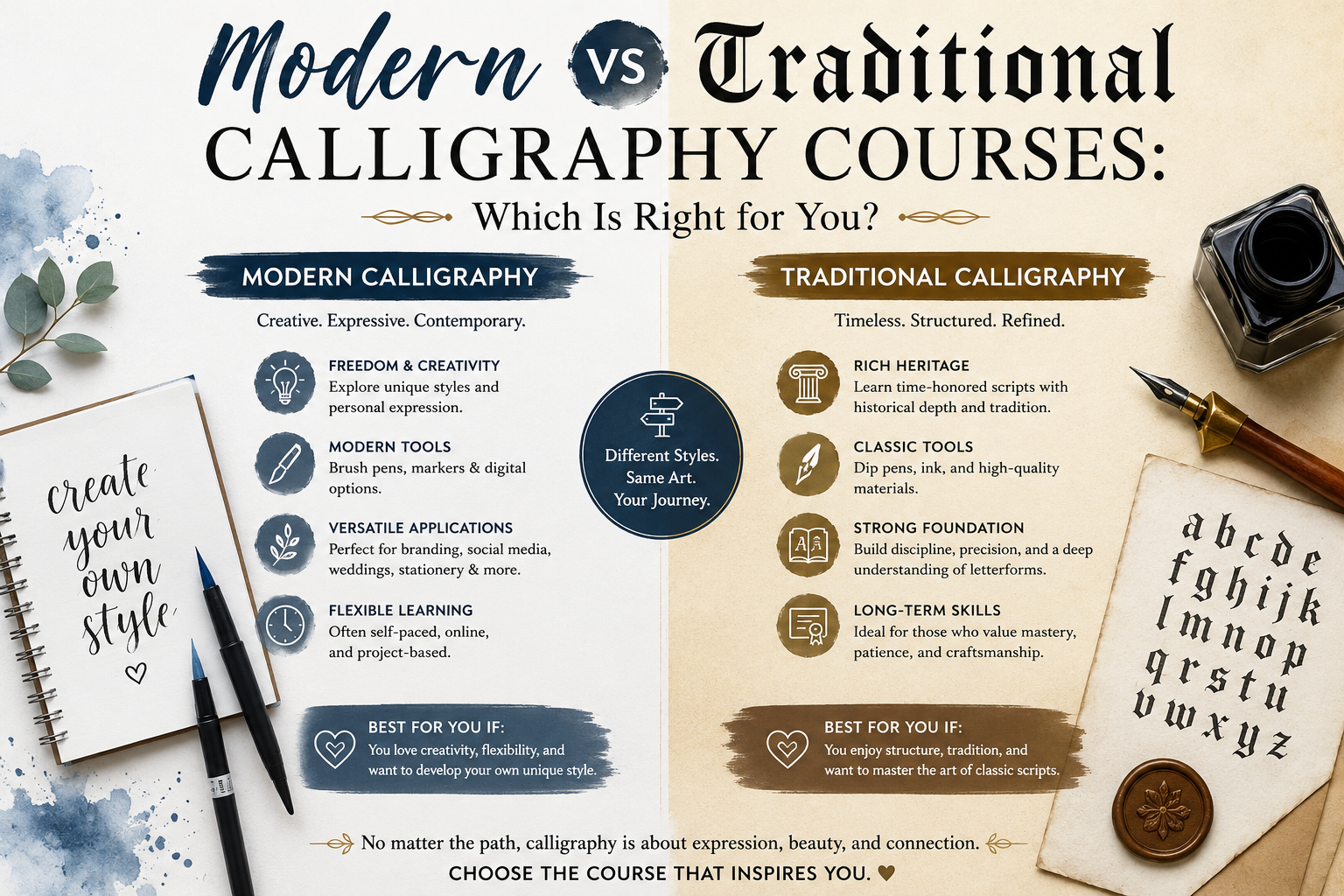


Choosing between modern and traditional calligraphy courses comes down to one question: do you want to master historical precision, or do you want to develop a personal, expressive hand quickly? Traditional calligraphy follows centuries-old rules for scripts like Copperplate and Spencerian, built on consistent letterforms and disciplined practice. Modern calligraphy trades that rigidity for bounce, flourish, and individuality, often producing usable results in a single sitting.
The global calligraphy market reached an estimated $1.8 billion in 2025 and is projected to grow at a compound annual rate of 8.5% through 2033, a sign that interest in hand lettering, whether classical or contemporary, keeps expanding rather than fading into digital obscurity. As a luxury calligrapher and engraver with over 18 years of experience working live events for brands like Veuve Clicquot, David Yurman, and Hayley Paige Bridal, I have trained students in both traditions and watched their goals shape which path serves them best. This guide breaks down the real differences, so your decision is based on outcomes, not guesswork.
What Traditional Calligraphy Courses Actually Teach You
Traditional calligraphy refers to scripts developed over centuries, each tied to a specific cultural or historical purpose. Copperplate, Spencerian, Italic, Gothic, and Japanese Shodo all fall into this category.
These styles were never decorative experiments. They were functional systems for formal documents, manuscripts, and ceremonial writing, which is why they demand exact proportions and stroke order.
A traditional course teaches you to repeat a single letterform dozens of times before moving forward. That repetition is the entire method, not a side effect of it.
Structured Rules and Stroke Discipline
In Copperplate, every downstroke and upstroke follows a fixed angle, typically 55 degrees from the baseline, with thickness controlled by pen pressure rather than pen width.
Deviation from these proportions is considered a flaw, not a style choice. This is what separates traditional practice from looser lettering work.
Cultural and Historical Depth
Japanese Shodo connects students to centuries of philosophy around breath, posture, and mindfulness, not just letterforms.
Learning Shodo or Gothic blackletter means absorbing the history behind the script, which gives the practice meaning beyond the page.
Tools Built for Precision
Traditional courses typically require pointed pens or broad-edge nibs, sumi or iron gall ink, and guide sheets that enforce consistent slant and x-height.
These tools are unforgiving by design. A shaky hand shows immediately, which is exactly why traditional training builds such strong fundamentals. The right starting kit matters here, and you can review the essentials in this guide to calligraphy course supplies before your first session.
Traditional courses ask for patience first and results later, which sets up the contrast with modern courses naturally.
What Modern Calligraphy Courses Actually Teach You
Modern calligraphy emerged as a deliberate departure from rigid historical rules, prioritizing bounce, bold flourishes, and personal voice over textbook accuracy.
It is frequently described as expressive lettering, where thick downstrokes and thin upstrokes still apply, but letter height, spacing, and slant can vary from word to word.
This flexibility is precisely why modern courses attract people who want visible progress fast.
Creative Freedom Over Strict Rules
Instructors in modern courses present the thick-thin stroke principle as a starting guideline, then encourage students to develop their own letter variations.
A single class can produce a finished, framable piece, which is rare in traditional training during the early sessions.
Beginner-Friendly Tools
Brush pens with flexible synthetic tips dominate modern courses because they forgive inconsistent pressure while still producing the thick-thin effect.
Markers, gel pens, and even digital tablets now appear in modern classes, lowering the cost and mess barrier for new students. If you are sourcing your first set, this breakdown of calligraphy supplies in Florida covers what beginners actually need.
Built for Events and Social Media
Modern lettering suits wedding signage, social graphics, and branded content because it photographs well and feels personal rather than formal.
Online demand reflects this shift. Surveys reviewed by industry analysts noted that platforms such as TikTok and Instagram have amplified hand-lettering and aesthetic stationery use, turning these practices into visible, repeatable routines for younger consumers.
That visibility is part of why modern calligraphy courses fill up quickly, and it leads directly into how the two approaches actually compare side by side.
Modern vs Traditional Calligraphy: A Direct Comparison
The clearest way to separate these paths is by looking at how they treat structure, tools, timeline, and end use.
Traditional calligraphy behaves like classical training, precise and historically grounded. Modern calligraphy behaves like improvisation built on a loose foundation.
| Aspect | Traditional Calligraphy | Modern Calligraphy |
| Rule structure | Fixed proportions, angles, and stroke order | Flexible guidelines, personal variation encouraged |
| Primary tools | Pointed pens, broad-edge nibs, sumi ink | Brush pens, markers, flexible-nib dip pens |
| Learning curve | Weeks to months for basic competency | Hours to days for usable results |
| Visual outcome | Formal, elegant, historically consistent | Playful, bouncy, contemporary |
| Best applications | Certificates, formal invitations, heritage art | Event signage, social content, personalized gifts |
| Practice format | Repetitive drilling of single letterforms | Free-form practice with immediate variation |
This table makes the tradeoff obvious. Traditional training rewards patience with long-term mastery, while modern training rewards experimentation with quick, usable output.
Neither path is objectively superior. The right choice depends on what you intend to do with the skill once you have it, which is also shaped by whether you learn in person or through a screen.
In-Person Versus Online Learning
Both modern and traditional styles can technically be taught online, but the hands-on correction of in-person classes tends to catch errors faster.
If you are deciding between formats, this comparison of online versus in-person calligraphy breaks down where each format actually delivers value.
Why Traditional Calligraphy Courses Are Worth the Investment
Traditional courses build something that modern lettering rarely does on its own: muscle memory for consistent, repeatable letterforms under pressure.
That consistency matters enormously for professional applications like formal invitations, certificates, and engraved keepsakes where every letter must match.
Discipline That Transfers Beyond the Page
The repetitive nature of traditional drilling strengthens fine motor control and patience, skills that carry into other detailed craft work.
Students who complete a full traditional course often find that learning a second script afterward takes a fraction of the original time.
A Genuine Connection to Heritage
Scripts like Shodo or Spencerian carry centuries of cultural context, and instructors typically teach that history alongside the technique itself.
This depth gives traditional practice a sense of purpose that purely decorative lettering cannot replicate.
Professional and Luxury Event Applications
Formal scripting remains the standard for high-end stationery, museum-quality certificates, and heirloom engraving work.
If you are aiming for professional-level event artistry, traditional foundations make your work read as intentional rather than improvised, which is exactly the standard I apply across my hand engraving and calligraphy work for weddings and brand activations.
That professional payoff is the strongest argument for traditional study, but modern courses offer a different, equally valid kind of payoff.
Why Modern Calligraphy Courses Appeal to Busy Beginners
Modern courses solve a real problem: most adults do not have months to spend before producing something they are proud of.
A single two-hour workshop can leave a student with a finished piece, a new hobby, and the confidence to keep practicing on their own.
Immediate, Visible Progress
Because the rules are guidelines rather than mandates, students see usable results in their first session, which keeps motivation high.
This immediate feedback loop is one reason modern lettering has become a popular stress-relief activity alongside other analog crafts.
Versatility Across Modern Life
Modern lettering adapts easily to wedding welcome signs, place cards, social graphics, and small business branding without needing formal training in a historical script.
Manufacturers and educators have responded to this demand directly. Analysts tracking the supplies side of the industry noted that the resurgence of analog hobbies as a stress-relief activity drove more shoppers toward physical tools in 2025.
Lower Entry Cost and Social Format
Brush pens and markers cost a fraction of a full pointed-pen setup, and many modern workshops are run in social settings like studios or private group sessions. For a closer look at what these classes actually cost, this guide on affordable calligraphy courses in Florida compares real pricing across formats.
That accessibility is why modern calligraphy has become the more common entry point for newcomers exploring the craft for the first time.
Both formats clearly serve different goals, which makes the decision process the next logical step.
How to Decide Which Course Fits Your Goals
Choosing between the two paths gets easier once you separate your motivation from the marketing around each style.
Ask yourself what you want the skill to do for you in six months, not just what looks appealing in a class description.
Start With Your End Goal
If you want to address formal wedding envelopes, certificates, or heirloom pieces, traditional training builds the consistency that work requires.
If you want signage for an event next month or a creative outlet for stress relief, modern lettering gets you there faster.
Consider Your Available Time
Traditional mastery typically requires weeks to months of regular practice before letterforms become consistent and confident.
Modern lettering can produce a usable, attractive result within a single class, which suits tighter timelines well. For a realistic beginner starting point, see the best way to learn calligraphy as a beginner in either style.
Think About Long-Term Direction
Many calligraphers eventually study both, using traditional structure to inform more confident, intentional modern flourishes.
Starting with whichever style excites you most is rarely a wrong move, since both build transferable hand-control skills over time.
Evaluate the Instructor’s Range
Look for instructors who can demonstrate both formal and expressive work, since that range usually signals depth of training rather than a single trick.
I built my own practice this way, training in traditional foundations before developing the freer, expressive lettering I now use across live calligraphy and hand engraving work for weddings, corporate events, and private celebrations. If you want guidance choosing a teacher who can move between both styles, this breakdown of what to look for in a good calligraphy instructor covers the qualities that actually matter.
Once you know your goal and timeline, the next step is finding the right setting to develop the skill, whether that is a guided course or a hands-on private session.
Blending Both Styles for Real-World Event Work
In professional event settings, the strongest results often come from combining both disciplines rather than choosing one permanently.
Formal invitations and place cards benefit from traditional structure, while welcome signs, favor tags, and social moments benefit from modern flourish.
Where Traditional Style Still Wins
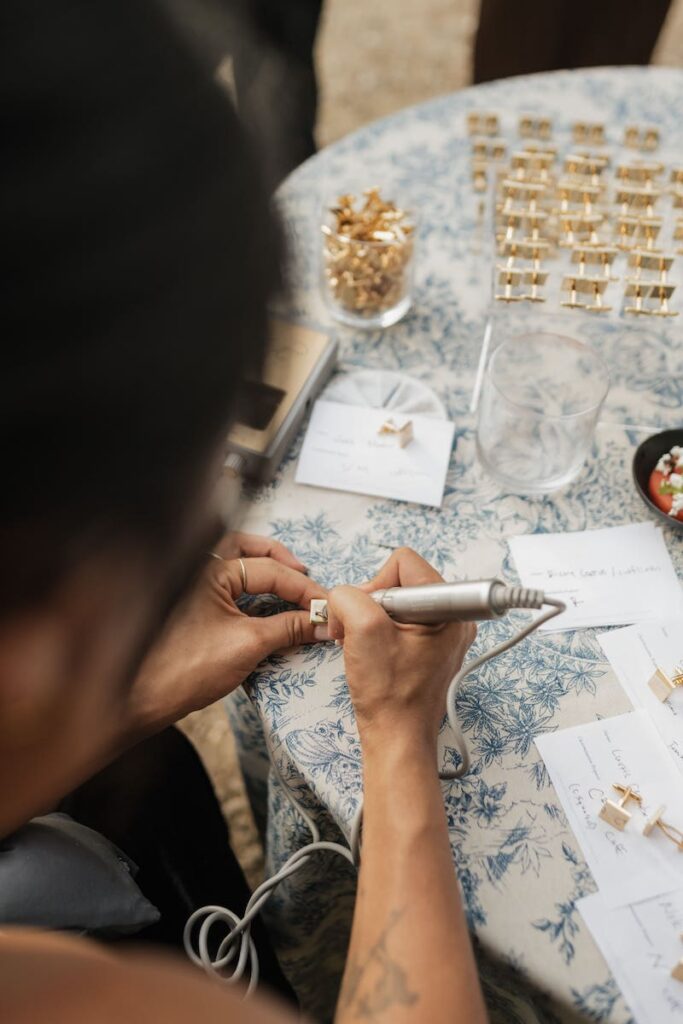
Engraved gifts, formal seating charts, and heirloom-quality pieces hold up best when the letterforms are precise and historically consistent, which is the standard I apply when clients book custom calligraphy for keepsakes meant to last.
Where Modern Style Adds Personality
Live event signage and guest-facing moments benefit from the warmth and individuality that modern lettering brings to a room, which is the focus of my event calligraphy work for weddings and brand activations.
Guests respond to it directly too. Live, in-person personalization tends to draw attention because watching a finished piece take shape in real time is part of what makes the experience memorable for guests.
This blended approach is exactly why structured, hands-on training matters more than picking a single label and sticking to it forever.
What to Expect From a Private or Custom Calligraphy Course
Group workshops are a great low-cost entry point, but private instruction offers something group settings cannot: a curriculum built around your actual goals.
A private course can move at your pace, focus on the specific script or style you need, and adjust based on how quickly you progress.
Personalized Curriculum Design
Rather than following a fixed beginner syllabus, a private course can start wherever your current skill level actually sits.
This matters most for adults returning to calligraphy after years away, or professionals who need a specific script for client work. The cost-benefit tradeoff between formats is laid out clearly in this guide on whether private calligraphy lessons are worth the investment.
Direct Feedback in Real Time
One-on-one correction catches small habits, like inconsistent pen angle or pressure, before they become permanent muscle memory.
That kind of feedback loop is difficult to replicate in a group class of twelve or more students sharing one instructor’s attention.
Flexible Format and Location
Private and small-group sessions can run as single intensive days or ongoing weekly practice, depending on your schedule and goals.
I offer this flexibility directly through my workshop offerings for students who want either a focused traditional foundation or a faster, modern-style introduction.
Whichever format you choose, the most important factor is consistent, intentional practice, which brings the conversation back to long-term outcomes.
The Real Cost of Learning Calligraphy in 2026
Cost is often the deciding factor for beginners weighing course formats, and the numbers vary significantly based on style and setting.
Group workshops for modern lettering typically run shorter and cheaper, while structured traditional courses or private instruction reflect a longer time investment.
Group Workshop Pricing
Most modern, beginner-friendly group classes fall in a moderate range per session, often including a basic kit of brush pens and practice sheets.
Traditional group workshops can cost slightly more when specialized tools like pointed pen sets or sumi ink are included in the price. A full breakdown by region and format is available in this calligraphy course cost guide for Florida.
Private and Custom Course Investment
Private instruction reflects deeper customization and direct mentorship, which is why custom sessions are priced differently from one-time group classes.
Custom private workshops with me start at a minimum project investment, reflecting personalized curriculum design and one-on-one feedback throughout the course.
Long-Term Value Consideration
Industry data shows continued growth in instructional spending. The supplies and tools side of the market alone was estimated at $500 million in 2025, with a projected compound annual growth rate of 7% through 2033, reflecting sustained consumer investment in learning materials.
Viewed against that backdrop, a private course is less an expense and more a foundation for a skill with growing cultural and professional relevance. For those weighing whether to eventually monetize this skill, it helps to understand how others have turned calligraphy into a business after completing formal training.
Cost matters, but the format you choose should ultimately track back to what you want the skill to accomplish, which brings this guide to its final point.
Choosing the Right Path for Your Calligraphy Journey
There is no universally correct answer between modern and traditional calligraphy courses. The right choice depends entirely on your timeline, your goals, and the kind of work you want to produce.
If you want disciplined mastery rooted in history, traditional training is worth the slower pace. If you want fast, expressive results for events or personal projects, modern lettering delivers that quickly.
Many calligraphers, myself included, eventually draw from both traditions to create work that is technically grounded and personally distinctive.
If you are ready to start your own calligraphy journey, whether through a structured traditional foundation or a faster modern introduction, explore my workshop offerings or reach out directly to design a course built around your goals. Your hand, your story, your letters: the only thing left to do is begin.
FAQ
Traditional courses follow fixed historical rules for consistent, formal letterforms, while modern courses use flexible guidelines that encourage bounce, flourish, and personal style from the start.
Modern calligraphy courses are typically easier to start with since brush pens are forgiving and usable results often appear within the first session, unlike pointed-pen traditional training.
Yes. Many calligraphers train in traditional fundamentals first, then apply that control to looser, modern lettering for events, signage, and personal projects.
Basic competency in scripts like Copperplate typically takes weeks of consistent practice, while true mastery and stylistic confidence can take several months to years.
Private instruction offers personalized pacing and direct feedback, which accelerates progress significantly compared to a fixed-curriculum group class, especially for students with specific professional goals.
Ready to Begin Your Calligraphy Journey?
Whether you are drawn to the discipline of traditional scripts or the expressive freedom of modern lettering, the best next step is hands-on practice with the right guidance. Book a private or custom calligraphy course with Carla Schall and start building a skill that is both technically sound and genuinely yours.