

Wedding escort cards are the smallest pieces of paper at your reception with the largest potential for detail errors, guest confusion, and last-minute stress.
They are also among the most personally experienced elements of any wedding. Every single guest interacts with one, holds it, reads their name on it, and carries it to the table.
Getting escort cards right, which means perfect wording, correct etiquette, a beautifully executed script, and a format that works with your seating logistics, is one of the most satisfying wedding planning wins you can achieve.
What Is the Difference Between an Escort Card and a Place Card?
This is the single most common point of confusion in wedding stationery.
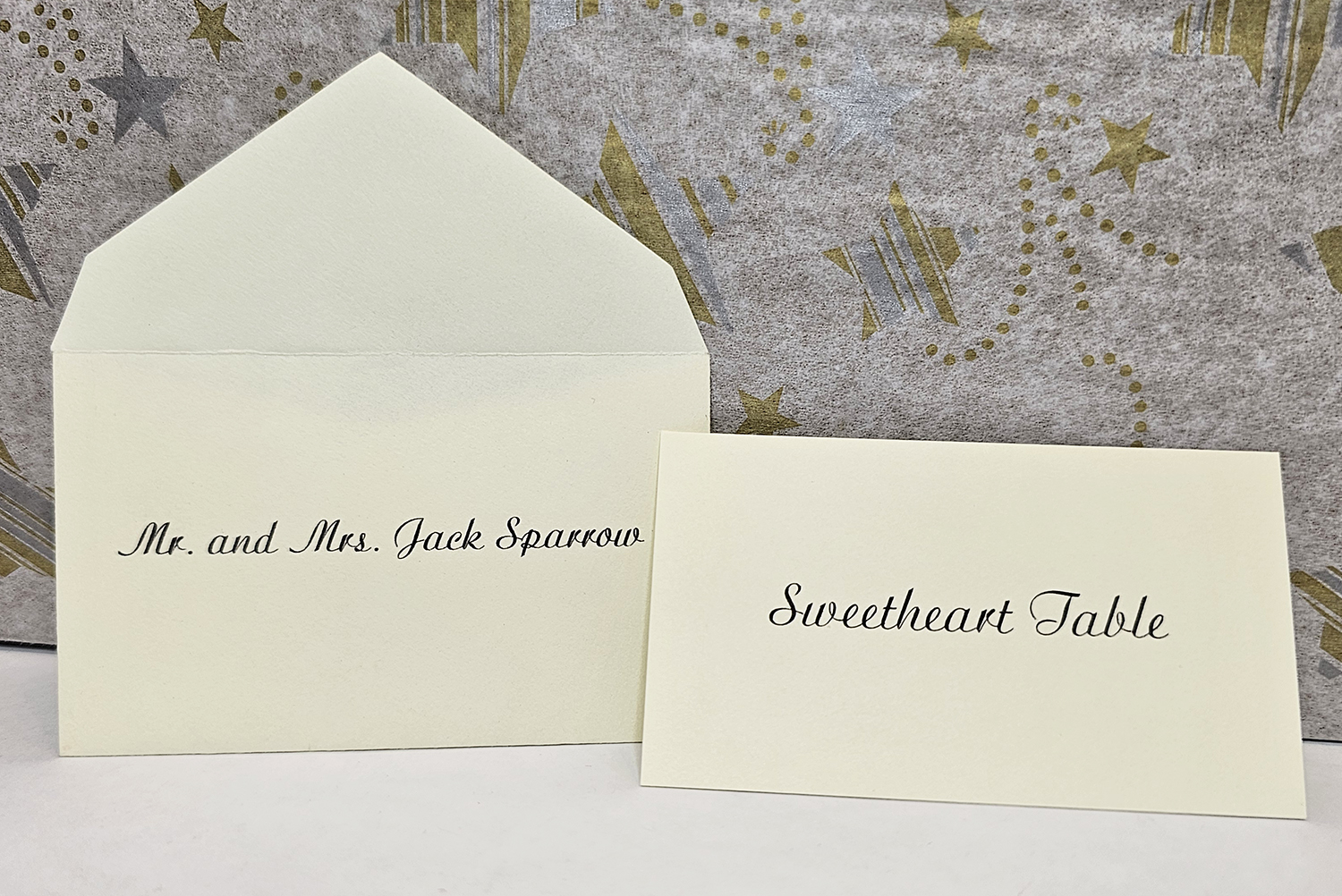
An escort card tells a guest which table they are assigned to but does not specify the exact chair at that table.
A place card is positioned at a specific seat at the table and tells the guest exactly where to sit.
Most weddings use escort cards rather than place cards for the practical reason that they give guests a moment of discovery during the cocktail hour, rather than requiring every guest to hunt for their name at the table itself.
Using both is also possible and is particularly common at very formal weddings with a highly specific seating plan.
Knowing the distinction before you create your list and submit it to your calligrapher prevents format confusion and ensures the display logic works correctly at the event.
Escort Card Wording: The Rules and the Nuances
Standard Wording Format
The standard format for a wedding escort card is:
Guest name / Table number or table name
That is it. No additional text, no greeting, no descriptive language.
The name appears in the most prominent script position (centered or top-aligned), and the table designation appears below it in a smaller, often complementary font or script.
Name Format: Titles and Couple Naming
For formal or traditional weddings, the etiquette for name formatting on escort cards follows specific conventions.
A married couple sharing a card: “Mr. and Mrs. James Harrington” A couple where both have professional titles: “Dr. Laura Webb and Mr. Thomas Webb” A single guest: “Ms. Amara Okonkwo” A guest whose title or preferred name is unknown: it is always preferable to ask than to guess.
For more casual weddings, first-name-only escort cards are increasingly common and are completely appropriate for informal or bohemian celebrations where the formal tone of titles would feel incongruous.
One Card Per Guest vs. One Card Per Couple
There are two schools of thought on this, and your calligrapher needs to know your preference before they begin.
One card per person allows every guest to hold their own individually named piece, which maximizes the personal feeling and is strongly recommended for weddings where calligraphy is a featured design element.
One card per couple or family reduces the total card count, which reduces calligraphy cost, but means that some guests do not hold a card with their own name on it.
For Florida brides navigating this exact decision, the recommendation from most experienced calligraphers is to do one card per person whenever budget allows, as the personal impact is significantly greater.
Calligraphy Styles That Work Best for Escort Cards
Escort cards are small, which means the script used must be legible at a small scale without sacrificing the elegance that makes calligraphy worth the investment in the first place.
Modern Script for Contemporary Weddings
A fluid modern script with slightly compressed letterforms works beautifully on standard escort card dimensions.
The organic character of modern calligraphy at this scale reads as warm and personal rather than overly casual, which makes it versatile across a wide range of wedding aesthetics.
Copperplate for Formal Events
A formal Copperplate or Spencerian-influenced script at escort card scale is one of the most beautiful applications of traditional calligraphy in the wedding context.
The precision of the letterforms and the consistency of the slant create a visual uniformity across a large display of escort cards that reads as exceptionally refined.
Italic for Clarity at Scale
For weddings with very long guest names or dual-language name requirements (common at multicultural Florida weddings), an italic script that prioritizes legibility over flourish is often the most practical choice.
Clarity must always take priority over decorative complexity on an escort card, because a guest who cannot read their name will have a poor experience regardless of how beautiful the script is.
The comprehensive guide to calligraphy styles for weddings addresses how different scripts perform at different scales and how to match script choice to your overall wedding aesthetic.
Display Formats for Wedding Escort Cards
How escort cards are displayed is a design decision that affects both the visual impact of the cocktail hour and the practical ease of guest navigation.
Flat Display on a Table
The most traditional format is a flat display of cards arranged alphabetically by last name on a surface, sometimes organized by first letter of the alphabet.
This format is highly functional and easy for guests to navigate, but it requires a large, dedicated surface and can look sparse or cluttered depending on the spacing.
Suspended Card Display
Cards hung with ribbon, thread, or wire on a vertical display structure create a dramatic visual installation that doubles as a cocktail hour decor element.
This format is highly photogenic but requires specific card design (a hole punch at the top, or a fold) and a carefully prepared display structure.
Seating Chart Plus Place Cards Hybrid
Some couples choose to display a calligraphed seating chart listing tables and guest names together, eliminating individual escort cards entirely.
This reduces calligraphy cost (one large piece rather than 100 to 200 individual cards) but removes the personal, held-in-hand experience that individual escort cards provide.
The full comparison of calligraphy seating chart versus printed escort card formats covers the design, cost, and logistical differences between these approaches.
Working with Your Calligrapher on Escort Cards
The key to a smooth escort card production process is clarity and completeness in the information you submit.
What to Prepare Before Submitting Your List
Your final guest list with names spelled exactly as you want them written is the single most important document in the escort card process.
Check and double-check every name. Spelling errors discovered after calligraphy production are expensive to correct because the affected cards must be remade entirely.
Include whether each guest should receive an individual card or a shared couple’s card, and flag any names with special characters, diacritical marks, or non-Latin scripts that the calligrapher needs to prepare for in advance.
How Many Extra Cards to Order
Always order 10 to 15 percent more cards than your confirmed guest count.
Extras are needed for: test impressions before the final run, any errors that occur during production, last-minute guest additions after the order is placed, and insurance against damage during venue setup or transport.
Timeline for Escort Card Production
Escort card production typically takes five to ten business days after a finalized list is submitted, depending on the quantity and the calligrapher’s current schedule.
For a wedding with 120 guests receiving individual escort cards, the production timeline is approximately one to one and a half weeks of active work.
Building in a buffer of two to three extra days between delivery and the wedding date protects against shipping delays or minor corrections.
What Escort Cards Cost in 2026
Professional calligraphy escort cards in the Florida market range from $2.50 to $6 per card for standard-format calligraphy on a card provided by the couple.
For cards supplied by the calligrapher in a specific stock or finish, add the material cost to the per-piece rate.
Metallic gold, silver, or specialty ink applications add approximately $0.50 to $1.50 per card to the base calligraphy rate.
The complete wedding calligraphy pricing guide for 2026 covers escort card pricing within the full context of a complete calligraphy suite budget.
Conclusion
Wedding escort cards are a small but deeply personal element of your reception that every single guest will interact with.
Getting the wording right, choosing a script that is both beautiful and legible, submitting a complete and accurate guest list, and giving your calligrapher adequate production time are the four pillars of a smooth escort card experience.
When all four are in place, the result is 150 small pieces of paper that collectively communicate more care and personalization than almost any other element in the room.
Let Carla create handwritten escort cards for your wedding → Contact Carla Schall
FAQ
Standard format is guest name on the top line and table number or table name below. For formal weddings, include titles (Mr., Mrs., Dr.) before names. For casual weddings, first-name-only cards are entirely appropriate.
Both are acceptable, but one card per person delivers a significantly more personal experience since every guest holds a card with their own name. Shared couple cards are more cost-efficient if budget is a primary constraint.
Professional calligraphy escort cards range from $2.50 to $6 per card in most markets, depending on script complexity and ink type. Metallic inks add approximately $0.50 to $1.50 per card above the base rate.
Submit your finalized, proofread list at least three to four weeks before your wedding date. This requires setting your RSVP deadline no later than five to six weeks before the wedding to give yourself adequate review time.
Order 10 to 15 percent more cards than your confirmed count to cover test impressions, last-minute additions, production corrections, and any damage during transport or setup.